Jainism and the Ranakpur Temple: Understanding the Principles

March 7, 2025


During our journey from Jaisalmer to Udaipur in Rajasthan, India, we stopped to visit a Jain temple in Ranakpur. After a long walk, we arrived at the temple’s entrance. Upon entry, the building’s dress code mandated covered knees and shoulders. Despite the temperature being in the upper 30s Celsius outside, the dress code prohibited sleeveless shirts. Fortunately, we were well-prepared to meet this requirement since we always wore long-sleeved shirts and pants while traveling.


Temple entry required removing all leather items, such as wallets and belts. Jain temples prohibit leather because producing it involves killing animals, directly contradicting the core Jain principle of “Ahimsa,” or non-violence. The temple provided lockers for visitors to store their items, and we had to improvise to keep our pants up after removing our belts.


At the entrance, we saw a sign advising women not to visit the temple while menstruating. This caught my attention, so I decided to research the source of this custom online. A social media comment explained, “In India, people are not allowed to visit a temple unbathed or in dirty or unwashed clothes.” Similarly, temple authorities prohibit any bleeding man or woman from entering, to maintain the temple’s purity and hygiene.


People have practiced Jainism, an ancient religion with more than five million followers for over five thousand years. It is based on the principle of peaceful coexistence and offers guidelines for living harmoniously with others. I was ready to become a follower. Unlike many other religions, Jainism does not worship a God; its followers revere the Tirthankaras. Jainism admires the 24 Tirthankaras—enlightened teachers or saints—for their teachings and wisdom, but does not worship them. They have achieved liberation from the endless cycle of birth and death.

A vegetarian diet is essential for all Jains, reflecting the core principle of non-violence or non-injury. Jains are very conscientious about their food choices. For example, they avoid root vegetables, such as potatoes, because harvesting them results in the death of the entire plant. Many Jains also operate animal shelters throughout India, showcasing their commitment to this principle.


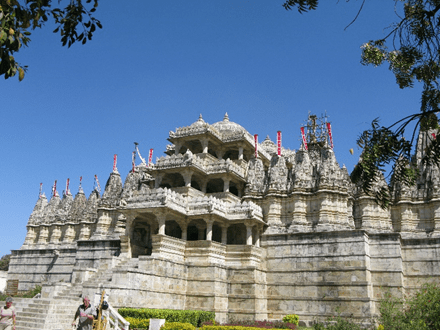
We learned that the Ranakpur Temple is one of the largest and most significant temples in Jain culture, recognized as one of the five most sacred sites for Jains. Remarkably, a dream inspired Darna Shah, a local Jain businessman, to build the temple in the fifteenth century. Of the renowned artists and sculptors he invited to submit designs for the temple, architect Deepak presented a plan that profoundly impressed Darna. Deepak promised to create a temple based on Darna’s vision. The king of the province provided land for the temple and suggested building a town near the temple, which has become Ranakpur.

The temple covers an area of nearly 48,000 square feet. It includes 29 halls and 80 domes, all supported by 1,444 intricately carved marble pillars, each uniquely designed. Four distinct doorways lead into its chambers. These chambers ultimately guide visitors to the main hall, where the statue of Adinath, the first spiritual leader of the Jains, is located. Remarkably, you will arrive in the central courtyard regardless of which of the four entranceways you choose.


The temple’s architecture is so well-designed that artificial lighting is unnecessary; natural sunlight illuminates the entire building. Construction began in 1389 and finished in 1458. The numerous openings and high ceilings kept the air inside significantly cooler than the scorching temperatures outside during our visit.

Exploring the Thar Desert: A Unique Rajasthan Adventure

March 6, 2025

While driving through the Thar Desert, the temperature soared into the upper 40s Celsius. Despite the heat during our travels in Rajasthan, our trip was filled with unique experiences, including an Ayurvedic massage, a camel ride in the desert, and accommodation in a Maharaja’s palace.

Many Maharajas lost their wealth and status after India gained independence, forcing them to find new ways to make a living. Many were left with nothing but their palaces, which they transformed into hotels. Our room in one of these palaces had an authentic atmosphere characterized by heavy curtains to keep the heat and noise out, aging period furniture, and a slightly musty smell. It was huge by North American standards. The luxurious palace made us feel important while we stayed there.

We had arranged for an Ayurvedic massage, advertised in the palace’s lobby, to be performed in our hotel room. Ayurveda, a practice that has been around for over five thousand years, focuses on balancing the body and mind. Practitioners use hot oils to promote healing and restore imbalances, and we were eager to experience it.

Two young therapists arrived—one woman and one man. Their English was limited, but they instructed me to lie on one bed and undress to my shorts, while Kathy undressed to her bra and shorts on the other bed. The therapists, dressed in business attire, covered our faces with towels before opening massive suitcases filled with various oils.

The room was quiet, and the warm oils, infused with fragrant herbs, helped us relax. I remembered a massage I experienced in Thailand, which ended with painful toe pulls. In contrast, the Ayurvedic massage was incredibly soothing.

The therapists advised to remain on the bed after the massage to allow the oils to seep into our skin until they dried and removed toxins. We had no trouble relaxing further; we were half-asleep by that point. After an hour of blissful peace, we got up to explore Jaisalmer (population 65,000 in 2011, 90% Hindu).

Walking around the city was challenging due to the narrow streets and roaming cows. At one point, a group of cows blocked Kathy as she tried to navigate her way. Many towns in India have laws against cows wandering freely, but Jaisalmer is an exception, marking our first encounter with numerous cows meandering about. (Cows are considered sacred by Hindus).

It was hard not to feel sorry for the cows, many of whom appeared half-starved and abandoned. I learned that volunteer veterinarian groups from overseas come to India to trim the cows’ hooves, allowing them to walk more comfortably. We often saw people feeding the cows before having their meals in the mornings. In the evenings, the cows usually rested or slept at the edges of the streets, having nowhere else to go.

On our way back to the hotel, we met an Indian man from Britain who expressed great disappointment in visiting his hometown. Contrary to his childhood experience, he found Jaisalmer to be backward and dirty. While we accepted what we saw as the norm, he wished the local government had done a better job in the city.

Our overnight camel safari in the desert began the following day. Due to the camels’ unique characteristics, we were advised to wear long pants to prevent irritation from their swaying and straw-like hair. Sunglasses and face coverings were also recommended in case of a sandstorm.

The safari started with a challenge: how do you get on a camel? We learned that when the camel is seated on all fours, one should climb up onto the saddle attached to its hump and lean back to avoid falling forward when the camel stands up, starting on its hind legs.

We began our camel trip on the outskirts of Jaisalmer, where we felt strange riding a camel. The roads were busy with motorcycles, trucks, bicycles, and two-wheeled camel carts with used airplane tires. People used camels as work animals. I initially thought I needed to control the camel in the traffic, but I quickly learned that this was not the case—camels listen only to their masters. In addition, our camels seemed to know exactly where to go.

Our leader walked beside his camel until we left the town and entered the desert. My camel followed the guide, a Raika tribesman. Kathy rode behind me, followed by two tribesmen and three additional camels carrying our gear.

The desert gradually enveloped us, and we continued riding in the heat until the leader suddenly stopped and unfolded a small prayer rug for himself to kneel and pray on. We also dismounted and stretched our legs to relieve any stiffness. Resuming the trip, we knew how to mount the camels.

At our camp, a couple of tribesmen set up an open-front tent equipped with cots and a small toilet tent for us. They also erected a collapsible table with chairs while the cook prepared our meals a short distance from our camp.

The temperature dropped significantly after sunset. The cook prepared mouth-watering curries for us, and we finished our meal with hot chai tea infused with cloves, cinnamon, and cardamom. A spectacular view of millions of stars in the sky appeared when darkness had fully descended.

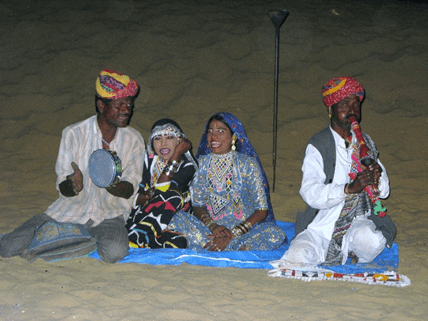
Suddenly, out of nowhere, a Gypsy family appeared with musical instruments. They began to play music next to our campfire, which was fueled by camel dung. The young girls started dancing in flowing, gold-braided dresses while their parents played unique musical instruments I had never seen before. The entire Gypsy family was dressed in colorful embroidered shirts and skirts, with the father wearing a turban on his head.

After the performance, we relaxed on our cots, gazing at the countless stars outside our open tent. I found myself wondering if the Gypsies were simply nomadic people who happened to see us in the desert or if, more likely, the organizers of our tour had arranged for them to perform for us.

Before drifting off to sleep, I thought about how majestic the camels were, with their slow, ambling gait. I also reflected on the Raikas, a local tribe in Rajasthan, who are actively working to protect the diminishing number of camels. Thanks to their advocacy, the government declared the camel the state animal of Rajasthan in 2014.

Entertainment at night in the desert.

Exploring Panjim and Old Goa’s World Heritage Sites

January 2, 2025


Arriving in Panjim, the capital of Goa, we made our way to our small hotel in the downtown area. Our contact there arranged a driver to go sightseeing.


The next day, the driver took us to Old Goa, where UNESCO declared a large area as a World Heritage Site in 1986. Sultanates ruled old Goa, founded in the fifteenth century on the banks of the Mandavi River until the Portuguese captured it in 1510. The Portuguese ran their colony from Old Goa until they moved the viceroy’s residence to Panjim in 1759. During their stay, the Portuguese had built several Catholic churches in and around Old Goa. With the viceroy’s departure, Old Goa’s religious significance diminished.

We walked over to the UNESCO World Heritage Site, which contains seven historical churches, one in ruins and the others in different stages of renovation. The builders constructed the churches in the Baroque architectural style. Although we found this site significant, it is less interesting architecturally. We have seen several more interesting World Heritage Sites in India (thirty-eight such sites in India).


Half a day spent wandering the buildings was adequate for us. It was a hot day with temperatures in the thirties (over 100 degrees Fahrenheit). We walked with our water bottles in the sun on the heritage site’s grassy field.

I recommend seeing the Basilica of Born Jesus on this World Heritage Site. It is famous for containing the remains of St. Francis Xavier, founder of the Jesuit Order, and associated artifacts, including his casket.


The other edifice we enjoyed was the Chapel of St. Catherine, a small building needing renovations but uncrowded and surrounded by vegetation providing welcome shade. Alfonso de Albuquerque built this chapel when he took possession of Goa in 1510 on Saint Catherine’s Day (November 25th). We took a hydration break at a small kiosk and called our driver for the return trip.


While heading back to Panjim, approximately ten kilometers down the road, the driver paused to grab a jacket upon getting a phone call. He said the police were monitoring taxi drivers further up the road, and the law required drivers to wear a formal dress or pay a hefty fine. I thought this regulation concerned creating a professional image for tourists.

According to the driver, in Goa, people view being a police officer as rewarding due to their ability to stop and search individuals for any reason. And people will negotiate and pay cash to avoid being fined. Applicants to the police force will pay bribes to get an interview. Families join to raise money for a family member who, if successful in becoming a police officer, supports the entire family

We walked around Panjim, which has a population of about 100,000. It has a European feel, with low-rise buildings and curvy streets. We enjoyed the many small stores lining the streets and stopped by an optometrist whose prices were low compared to prices in Canada. They offered us a plan whereby we gave them our prescriptions, and they would fill them at any time at a low cost for an annual fee. We considered it but decided against it, thinking of the time it would take to get glasses mailed to us. Shoppers and passersby were helpful with directions to the Bishop’s Palace; however, the impressive, two-story building was closed on our arrival.

The next day, we visited a beach, a major tourist attraction in Goa. Thinking an hour would get the smell and atmosphere of the beach; we told the driver to wait. Upon stepping onto the sandy beach, hawkers surrounded us, trying to rent umbrellas, sell refreshments, and offer massages. I struggled to shake them off without resorting to discourtesy. It was not a pleasant experience. Their presence stemmed from business opportunities.

Understanding the language, I listened to the Russian tourists on the beach availing themselves of the full range of services. Also noticeable were the women in long sarees, which they wore into the water with their children. An early bedtime preceded our 4:30 AM flight. My anxiety grew with each passing moment as the cab failed to arrive. I called the driver several times and was told he was on the way. He explained his tardiness one hour late: the airport was only 30 minutes away, and a few flights meant no rush. He was right, and we boarded Qatar Airways to Doha and Washington, DC, connecting with a United Airways flight to Ottawa. We arrived on the same day as the day we left, even though we had twenty hours of flying time with five hours’ waiting time in between flights.

Cultural Insights from a Kerala Tour Guide


December 27, 2024

Heavyset, with an average height and a dark face, Dinesh was our guide in Kerala. He grew up in Kochin, his birthplace. Malayalam, the official language of Kerala, was his mother tongue, although he spoke English but with an Indian accent. Over a couple of weeks, we had gotten to know him. Married with two small children; his family surely missed him while he traveled constantly for work. We found him easy-going, affable, personable, and eager to please us.

Everything about him was clean; he wore a clean shirt daily, befitting a professional chauffeur and guide. Although I never asked him, it impressed me how he got his impeccably starched shirts every day. He must have carried many shirts or had them cleaned overnight. Similarly, his car was shiny and always impeccably clean, and the interior was spotless. No objects, like the newspapers we read on the road, were ever left behind. His company’s car was like a jewel to him, and he hoped to buy it soon. Years later, I saw him showing off “his” car on Facebook.

Proud of his country, he showed and described it to us in glowing terms. His work was very important to him, and he related his experience with the English chef Gordon Ramsey collecting recipes for a book on Indian cooking. Dinesh showed us a photograph of Ramsey, his crew, and himself for emphasis. Impressed, Kathy bought a copy of that book in Kerala.


I noticed he was conscious of his class, a reality in some countries, including India. He deferred to others, whom I assumed he considered high-class people. It always happened when we invited him to eat lunch with us. He excused himself by claiming to be busy.


But once, we asked him to take us to a local Indian restaurant, a highway stop. There, we had thali food on grape leaves filled with curries. Looking around, I noticed that most of the people looked like laborers. He did not hesitate to sit with us and explain our food. After we ate with our fingers, local style, we washed our hands in the sink at the end of the dining hall.

At another time, we invited him to dinner to discuss the next day’s plans. He did not want to join us, perhaps because it was a more expensive restaurant. We were forceful and did not take no for an answer. He obliged us. When the waiter came, he gave Kathy and me menus, but not Dinesh. Even the local people knew and discriminated according to what class they were serving.

I requested an extra menu for Dinesh, which the waiter provided. We were all served, but I knew Dinesh was uncomfortable throughout the dinner. He remained silent, avoiding eye contact. Later, I realized we may have asked too much of him by insisting he eat with us. What we thought was normal was not for him.

 After days of traveling with Dinesh, I noticed he did not come into the hotels with us; he dropped us off. I remember the Tharawad Homestay, where he left us with the details of when he would pick us up the following day. Drivers were not permitted to park in high-end residential areas or obstruct driveways. We learned he slept in the car every night.

We were on a tour, and the tour operator paid for all our hotels but provided no accommodation for our guide. He had to find a place to park and sleep overnight. I do not know how he looked so fresh every morning, drove us around Kerala, and provided knowledgeable comments. I follow him on Facebook.

Kanyakumari’s Sunrises, Statues, and Spiritual Significance

December 24. 2024


Kanyakumari, located at India’s southernmost point, is where the Bay of Bengal, Indian Ocean, and Arabian Sea converge. The sunrises and sunsets were vivid on a clear day, and we saw the moon rising on one side while the sun was going down on the other. We were eager to witness the bay’s unique three-colored seas, a natural wonder, and its importance in Indian burial traditions. It is a mecca; people bring the ashes of their loved ones from all over India to toss into the waters at the southernmost tip of India.

View from our balcony: Thiruvalluvar Statue and Vivekananda Rock Memorial


Dinesh showed us the Thiruvalluvar Statue and Vivekananda Rock Memorial from our waterfront hotel, two major attractions on a large rock outcropping several hundred meters offshore. From our room facing the bay, we watched the ferries transport people to the Rock throughout the day. The crowd below enjoyed bathing in the water, and long lines waited for the ferry to take them to the Rock.


I discovered the place where the crowd bathed was blessed. Let me recount a Hindu legend to explain. The name Kanyakumari comes from Goddess Kanyakumari, the sister of Krishna. Hindus revere Krishna, one of the most popular Indian divinities, as the supreme God, embodying compassion, tenderness, and love. His sister Kanyakumari is a goddess to whom women pray to get married.

Hindu legend says Goddess Kanyakumari’s wedding to Shiva, a main Hindu deity, was ruined when he didn’t show. Rice meant for the wedding remained uncooked and unused. The uncooked grains turned into stones as time went by. Legend says the small, shore-side white stones, resembling rice, are from a wedding that never took place. Kanyakumari, now seen as a virgin goddess, bestows blessings on the many pilgrims and tourists visiting the town of stones. So the bathers were on blessed grounds.

From the balcony, we had a clear view of the Thiruvalluvar statue. The pilgrims reached it by ferry, which departed every half hour, fully loaded. Instead of going there, we felt our time would be better spent reading up on what the statue represented.


Thiruvalluvar, which means Saint Valluvar, was an Indian poet and philosopher. He wrote the Tirukkural, a treatise on virtue, love, and wealth in short couplets of seven words, called the kurals. Scholars date the text variously between 300 BC and AD 500. Saint Valluvar is one of Tamil Nadu’s most famous philosophers, and the Tirukkural is considered a secular work on morality and ethics.


Officials unveiled the statue on January 1, 2000. Interestingly, the artist who designed it related it to the Tirukkural; the statue is 133 feet high, corresponding to the 133 chapters in the Tirukkural. Although I could not find why the statue was there, it is a striking location in the ocean, four hundred meters from the shoreline.

We got up at 4:00 am and took pictures of the sunrise on one side and the moon receding on the other. Then, we went down to the port to join the crowds. We walked around the people and talked with some who spoke English; they had slept there overnight to ensure they could get on the ferry early in the morning. Along with the crowds, we visited the Mahatma Gandhi Memorial (Gandhi Mandapam), where the urn containing his ashes was kept for public viewing.


There was not much to see at the Memorial except the modern architecture. Mahatma Gandhi visited Kanyakumari in 1925 and 1937. Twelve urns containing his ashes were dispersed across the nation following his 1948 demise. They brought one urn to Kanyakumari and placed it where they built the Memorial. Construction was completed in 1956.


The central spire of this Memorial is 79 feet high, reflecting Gandhi’s age when he died. I was reminded of the Thiruvalluvar statue—its height correlating to the number of chapters in St. Valluvar’s book—when I saw how this building incorporated an aspect of the person it memorializes. On Gandhi’s birthday, October 2nd, sunlight shines directly on the spot where his ashes are kept in the Mahatma Gandhi Memorial building, thanks to a strategically placed ceiling opening.

Workers constructed the Vivekananda Rock Memorial in 1970 to honor Swami Vivekananda. Vivekananda, born in 1863, was a chief disciple of the nineteenth-century Indian mystic Ramakrishna and introduced the Indian philosophies of Vedanta and Yoga to the Western world. He died in 1902. But it was not just the Swami who interested me. It was the process by which the Memorial had taken shape.


In 1963, during the centenary of Swami’s birth, a Hindu committee in Kanyakumari recommended that a memorial be constructed on the Rock about 500 meters from the shore. Local Catholic fishermen opposed the plan, staging a protest that included a large cross placed on the Rock; however, it vanished overnight. This controversy became a political issue, and the local politicians escalated it to Madras, now Chennai, the capital of Tamil Nadu.


 The controversy continued in Chennai, with opposition from a politically powerful state minister who thought a monument would destroy the natural beauty of the rock island. Eknath Ranade, an activist, pushed for the memorial by raising the matter in Delhi, lobbying representatives, and gathering enough signatures to persuade Prime Minister Nehru to approve it. This story and process were not atypical of similar efforts in North America.

The night before our departure to Bangalore, on the way to Goa, we lounged by the pool of the Pappukuty Beach Resort in Kovalam. In the pool, I had a very informative and pleasant conversation with an Indian in the high-tech field. We discussed the superb high-tech professionals India’s Institutes of Technology (IITs) educate.

 India boasts over a dozen IITs, including those in Delhi, Mumbai, and Chennai. A tutoring industry has emerged to help students gain admission to these prestigious universities, which receive more government funding than other institutions. But beyond good technical education, are other factors that make Indians successful in high-tech?

My newly found friend in the pool suggested that the English colonials left a management-oriented culture for the Indians after independence. He also thought that the English language, widely used in India, had been an advantage for Indian techies over those from countries without strong English language skills, such as China. My new friend says Indian culture emphasizes consensus over directives, which makes Indians naturally adept at collaborative management, which is crucial for modern success. Given the success of Indian CEOs at companies like Microsoft, Google, Nokia, Sun, and Adobe, it was hard to disagree with his perspective. On the last day, Dinesh took us to the Trivandrum Airport, and we said goodbye to each other. He became quiet and serious. Over two weeks, we had bonded and gotten used to each other’s company and would miss each other. However, our trip to Goa provided a welcome distraction from missing him.