Residents Voice Concerns at Fisher Heights Community Meeting

October 12, 2025

The Annual General Meeting of the Fisher Heights and Area Community Association turned into a session filled with complaints. Though the term “bitch session” might seem harsh, it accurately described the atmosphere.

The President began the meeting by summarizing the association’s events from the past year and spent about ten minutes reviewing the financial statements. After that, he opened the floor for discussion, with the local City Councilor present at the head table.

The first concern raised by a resident, amid the mostly grey-haired and entirely white attendees, was the rat population thriving in his home. Many others joined in, revealing that the area is facing a significant rat problem. I recalled that this same issue was discussed last year, with residents blaming the increase in rats on the construction of the Light Rail Transit (LRT) system downtown. The excavation for the underground rail disturbed the rats, causing them to migrate into the suburbs—specifically, into our neighborhood. No solutions were proposed last year, and using poison was deemed not an option since children lived in the rat-infested area.

 Our councilor addressed the discussion by explaining that the city is taking the rat issue seriously and has started mapping the geographic areas where rats thrive. Residents are encouraged to report any rat sightings in their homes to the city. The councilor also mentioned that a rat committee has been established, and a dedicated section about this issue has been created on the city’s website.

Additionally, the councilor advised us that rats tend to flourish in “messy woodpiles,” “overgrown grass,” and “compost bins.” He urged residents to clean up their woodpiles, maintain their lawns, and consider limiting or discontinuing composting altogether. While this advice is practical, it may not be well-received by those who enjoy composting. Although the information provided was helpful, it remains unclear how these measures will effectively improve the situation in our community.

The discussion then shifted to parking problems in the community. Residents voiced strong objections to having parked cars in front of their homes, even when those vehicles were on public streets. Their concerns appeared to arise from a desire to prevent strangers from parking near their houses. This situation raised questions about whether their objections were related to safety, the aesthetic appeal of the neighborhood, or simply a feeling of ownership over the street in front of their homes.

In response, our councilor suggested that larger households in our area were contributing to this issue. This statement was surprising, as our community has been aging, resulting in fewer children. So, where are all these new residents coming from? One possibility is that the rental complex in our area has begun charging for visitor parking, which forces guests to park on public streets. Others pointed out that many young adults are staying at home with their parents because they cannot afford to buy their own homes. The councilor also noted that redevelopment in the area has led to higher housing densities, resulting in more households in the community and, consequently, more cars on the streets.

Many audience members asked why the city cannot install more no-parking signs. The councilor explained that no-parking signs are placed only in areas where intersections create dangerous driving conditions. In these instances, people often find alternative parking spots elsewhere in the neighborhood, which means the identified parking issue is simply shifted to another location. This approach hardly resolves the problem!

Additionally, parking is becoming a bigger issue due to the new zoning bylaw, which reflects the city’s growing population. The city council views densification as the only solution, aside from an unlikely massive investment in public transit. Ultimately, higher population densities will lead to more cars on the streets.

Another topic discussed was the overflowing garbage bins in city parks. Since we have curbside garbage pickup, someone asked why the garbage truck doesn’t also empty the garbage containers in the parks when it passes by. The councilor explained that this is more complicated because the public works and parks departments use different contractors for garbage collection. Could better coordination between the two departments improve efficiency and reduce costs? I wondered if the councilor would consider taking this suggestion back to the city for further discussion.

Continuing on the topic of our parks, someone raised a concern about the absence of no-smoking signs in these areas. This individual observed people smoking cannabis in public spaces—likely due to the smell—where young school children walk. I thought we had already implemented a bylaw regarding this. The councilor responded by discussing the challenges of enforcing a no-smoking bylaw in city parks. He mentioned a shortage of bylaw enforcement officers and indicated that enforcing such a bylaw was not a top priority. Additionally, the potential revenue from this bylaw would be minimal compared to the significantly more profitable option of ticketing for illegal parking.

Another individual complained about loud construction noises at night. A construction company working on a high-rise building accidentally damaged a water pipe, necessitating emergency repairs overnight. The infrastructure maps provided by the city to the company failed to mark the location of this major water pipe, which supplied water to a nearby dialysis clinic. Restoring the water supply became urgent.

The person who raised the noise complaint stated that she was not concerned about the work at the dialysis clinic; rather, she objected to the nighttime noise, which deprived her of sleep. This comment troubled me, not only because of her lack of understanding of the situations that can arise on construction sites, but also due to her apparent lack of compassion for the patients at the dialysis clinic. To compound her complaint, she asked if the contractor was fined for breaking the water pipe. My goodness! It was an accident! Moreover, it was the city that provided an outdated map. Should the city fine itself for that?Continuing on the topic of our parks, someone asked why there are no no-smoking signs in these areas. This individual observed people smoking cannabis in public spaces (I assume he noticed it by the smell) where young school children walk. I thought we already had such a bylaw. The councilor addressed the topic by discussing the challenges of enforcing a no-smoking bylaw in city parks. He mentioned the shortage of bylaw enforcement officers. He indicated that enforcing such a bylaw would not be a top priority. Additionally, the potential revenue generated from implementing this bylaw would be minimal compared to the significantly more profitable option of ticketing people for parking illegally.

Still another person complained about loud construction noises at night. A construction company working on a high-rise building accidentally damaged a water pipe, necessitating emergency repairs overnight. The infrastructure maps provided by the city to the company failed to mark the location of a major water pipe. Since this pipe supplied water to a nearby dialysis clinic, restoring the water supply became an urgent matter.

The person who raised the noise issue stated that she was not concerned about the work at the dialysis clinic; instead, she objected to the nighttime noise, which deprived her of sleep. This comment troubled me not only because of the lack of understanding for a situation that is likely to occur on construction sites, but also due to her apparent lack of compassion for the patients at the dialysis clinic. To compound her complaint, she asked if the contractor was fined for breaking the water pipe. My goodness! It was an accident! Moreover, it was the city that provided an outdated map. Should the city fine itself for that?

At that point, I had reached my limit with the complaints and decided to leave the meeting. I found myself questioning the positive actions the association had taken over the past year. I heard that they had painted some lines on a basketball court, replaced the flooring in the community center, and allocated funds for a bicycle repair station in one of the parks. They also organized several community events, including this meeting, where residents could voice their concerns and speak with our councilor. While these are positive steps, I wondered if they were sufficient to justify the existence of a community association.

As I drove home, I realized that the meeting did not address the various clubs the association sponsors, such as a bridge club and fitness classes in the community center. Including presentations from these clubs could have been beneficial, as it might have encouraged more people to participate in the association’s activities. I also questioned the absence of a proposed budget outlining the association’s priorities for the upcoming year. I left the meeting feeling that it was a missed opportunity to make the association more relevant to the community. Overall, I don’t think our community has any significant issues at this time.
Exploring Granville Island: A Vibrant Vancouver Destination

May 29, 2025

Granville Island is a vibrant thirty-five-acre urban district located under the Burrard Bridge in Vancouver. Due to limited parking, we chose to take an Uber to get there. Granville Island is the most visited tourist destination in Canada after Niagara Falls, attracting over ten million visitors each year.


The sandbar that is now Granville Island was a traditional fishing site for the Squamish and Musqueam tribes. The early 1900s saw industry’s expansion into the land, supporting the maritime and lumber industries. Until 1972, hobos lived on the island before the federal government took control. Ron Basford, the minister responsible for the lands, envisioned redeveloping the area while preserving the original buildings and businesses. His vision ultimately grew into a roaring success.

There are no sidewalks here; the planners envisioned a pedestrian district. The streets are narrow, filled with throngs of people moving through the walkways. There are also three thousand people working on the Island. Cars move extremely slowly along the crowded streets. We initially thought a line of vehicles on the main street was a parking lot, but then the cars began to move—it was not a parking lot after all.


The taxi dropped us off at the Public Market, a large, renovated warehouse filled with a variety of merchants. The market features bakeries, fruit and vegetable stands, butchers, as well as specialty cheese and international food vendors. After noticing a lineup at the BC salmon seller, we decided to purchase some in a freeze-dried bag to take home. Of course, we couldn’t resist getting fresh, sweet cinnamon buns from a local bakery, so we hurried over to a roaster for their exceptional coffee to enjoy with the buns. There was a line at the coffee shop as well. We learned that all fifty merchants in the Public Market are local, and no chain stores are allowed.


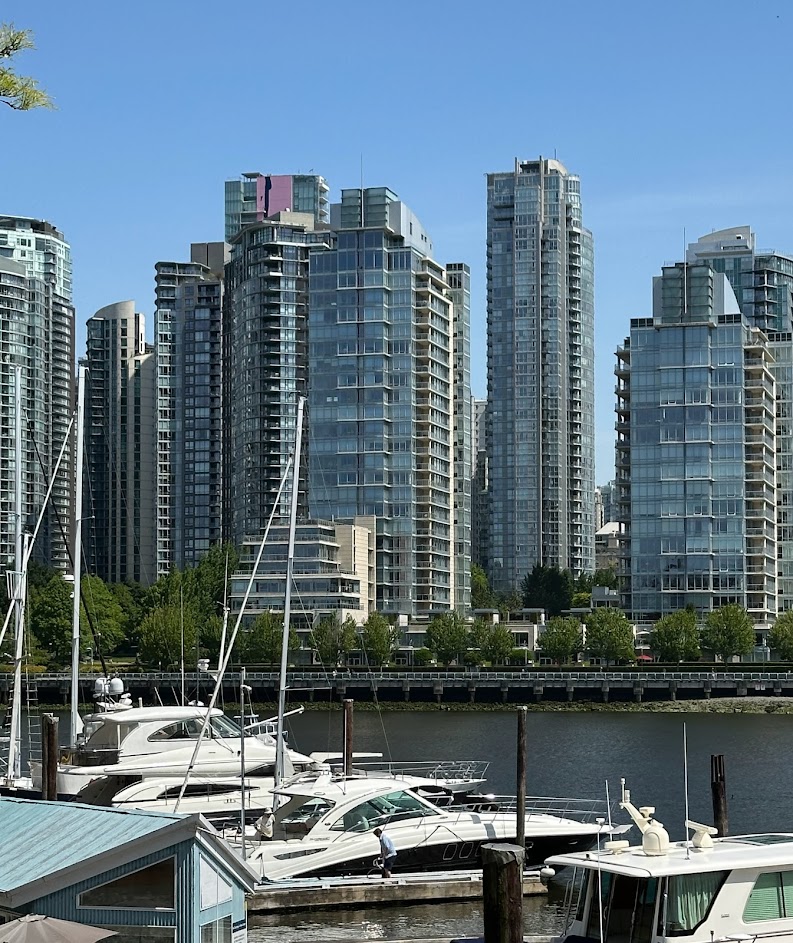
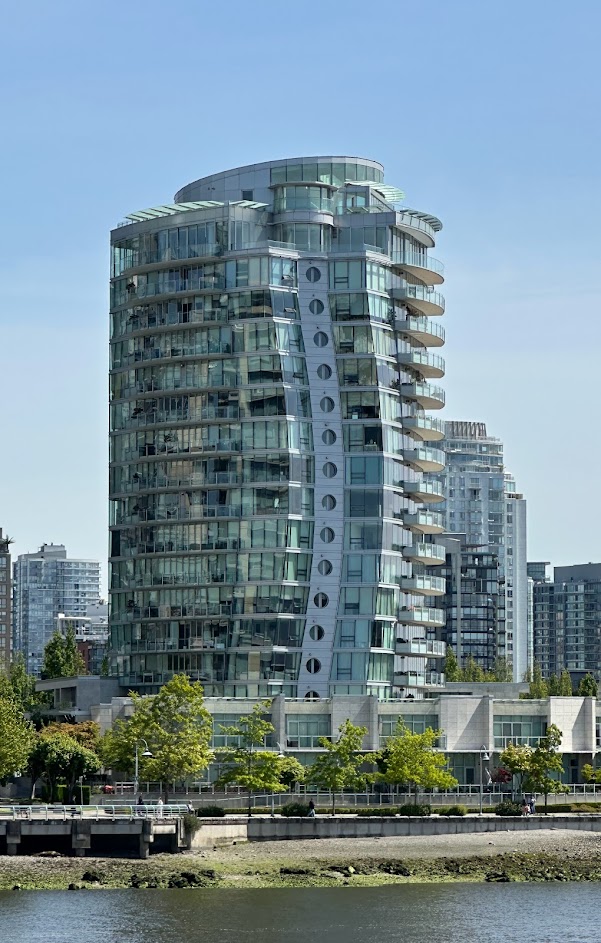
To enjoy our sweets and coffee, we sat in the outdoor plaza outside the Public Market on the waterfront. The skyline of downtown Vancouver stretched before us, resembling a mushroom of high-rise buildings with attractive designs. Each unit appeared to have a balcony, allowing residents to take advantage of the surrounding views. Among them was a distinctive high-rise designed by Arthur Erickson, one of Canada’s most renowned architects. This unique apartment building bulges in the middle, making it an eye-catching sight. Although it may seem unusual, it stands out from the typical apartment towers.

As we walked along the waterfront, we noticed several houseboats tied up at the dock. Interestingly, most of these houseboats are two stories high and seem to be permanently moored to the shore. It makes you wonder what it would be like to live on a houseboat in downtown Vancouver. Would the residents have children? There are no schools or playgrounds on the island, although educational facilities are available on the mainland. Is this lifestyle suited only for adults?


There are two rows of boats tied up—one along the wall and the other tied to the first row of houseboats. I wonder if the first row of houseboats, which is next to the shoreline, is cheaper to dock but lacks a view because the second row of boats is parked in front of them. The density of the boats is so great that they are touching each other! Is there any privacy here? One would assume that good neighborly relations would naturally develop.


As we walked between renovated buildings, we passed restaurants, a community center, and many performing arts theaters. The Emily Carr University of Art and Design is also located there. We walked by the Granville Island Brewery, but it was too early for a beer.


Forties music drew us to a large plaza in front of the Ocean Concrete Company, the longest-established tenant on the Island since 1917. This cement factory features concrete silos decorated with a colorful mural by the Portuguese brothers Pandolfo, titled “Giant.” Despite the huge cement trucks parked in front, the mural made the industrial neighborhood feel more appealing. The music was coming from an outdoor free concert performed by the Firemen’s seventeen-piece band. We stood and listened to my favorite style of music until a few chairs became available in the plaza, allowing us to sit down.


Leaving the music behind, we walked along the waterfront, taking in the views of Vancouver’s skyline and False Creek. The wooden boardwalk felt comfortable under our feet. As we strolled, we passed by an upscale waterfront restaurant that is part of the luxurious Granville Island Hotel, our destination from which we called an Uber to return home.


Although we spent only a few hours on the Island, we could have easily spent the entire day exploring the galleries and studios of local artists, visiting the cement factory that offers tours, and enjoying the brewery.
The mixed land uses, the variety of local shops, the vibrant arts scene, and the bustling crowds reminded me of Jane Jacobs’ ideas about urban environments. Her philosophy is detailed in her bestselling book, “The Death and Life of Great American Cities,” published in 1961. Jacobs advocated for the renovation of old districts by preserving buildings, promoting mixed land uses, and encouraging high-density living with numerous streets to create dynamic urban spaces. She vehemently opposed urban renewal and redevelopment, especially those led by professional planners, favoring instead organic growth guided by local communities. Granville Island serves as a prime example of her principles in action.

Celebrate with Mother’s Day Brunch and Dinner Recipes

May 14, 2025

It has never failed. Each year, on Mother’s Day, the same question arises: “What will you do for me?” My response consistently points out I am not your mother; you are my wife. However, as usual, this was not the correct reply, so I offered to prepare breakfast, not just the usual fried egg and toast, but something better.

The children always call on Mother’s Day, but they can’t fix meals at our house since they live thousands of miles away. The first call came at eight; I initially thought it was a prank call. Luckily, I decided to pick up the phone.

After reviewing various recipes, I chose to make Shakshuka by Ottolenghi (and I’m sure I don’t need to describe Ottolenghi to cooking aficionados). This light and refreshing Middle Eastern dish features diced tomatoes, red peppers, and spices like harissa and ground cumin. My son, Tony, mentioned that they served it every morning at the breakfast counter in his hotel when he was in Israel.

Some recipes I read for shakshuka also called for onions, which I like, and I decided to modify Ottolenghi’s recipe and diced up a large onion. After boiling and simmering these ingredients, I cracked the eggs into the dish and cooked for an additional 10 minutes to set them. I served it with pita bread and caffeinated coffee; we drank decaf in the morning. This meal served more as brunch than breakfast, which was good since it took me a while to get everything organized, and it was getting late in the morning. Since the recipe yielded four portions, and we ate them all, we were set for the day.

I must admit, though, that I had help from Kathy. My cooking is slow and tedious, as I prefer to gather all the ingredients on the kitchen table and prepare the food before I start cooking. I diced the peppers and onions (and used a can of diced tomatoes) and mixed the spices and garlic in a small dish before beginning to cook. Kathy became hungry and started cooking with the prepared ingredients.

After indulging in a rather large brunch, we took a long walk to burn some calories. We enjoyed a peaceful stroll along a rail-to-trail path in Stittsville. As is typical for rail-to-trail routes, the walk was straight and flat. On our return, we stopped at my favorite coffee shop, the perfect way to end any walk. Naturally, the next topic of discussion was what to have for dinner.

Feeling inspired, I offered to prepare dinner and suggested fresh salmon steaks. Kathy agreed it was a great idea, so I bought two slabs of Atlantic salmon with the skin on one side at the local fish market. I like to marinate the salmon using a mix of soy sauce, maple syrup, and grainy Dijon mustard, based on a recipe I found on Allrecipes.

I enjoy this recipe – maple glazed salmon – because I can roast vegetables on the same sheet pan as the salmon. This time, I had some cauliflower in the fridge, so I cubed it, tossed it with oil and salt, and baked it for 15 minutes before adding the salmon to the pan. I also bought some Tater Tots and put them on the sheet pan, which drew some criticism from Kathy; she believed frozen French fries were healthier than Tater Tots. They were similar in nutritional value, so I chose the Tater Tots for their appealing cubic shape. To cover all bases, I also cooked a potato in the microwave in case the Tater Tots didn’t meet with acceptance. The dessert consisted of low-fat lemon yogurt topped with blueberries. The dinner was enjoyable, despite the lack of family, a common situation today as families are frequently scattered across North America and globally for many.

Exploring Delhi: A Day in India’s Bustling Capital

January 19, 2025


We flew to Delhi, where we spent one day—quite an introduction to India! Our hotel was outside of Delhi’s center, accessible by subway. Shyaam, our guide, led us on a subway journey to Old Delhi’s historical sites and bustling market. We followed Shyaam through the crowded streets. The heat made me wipe the sweat from my face. It felt as if we walked a long way, only to discover that the distance covered was only a few blocks.

Rubbernecking to see the small stores and fighting the jostle of people was tiresome. After a while, we were ready for a snack and looked longingly at the street vendors with their steaming foods. Shyaam cautioned us about buying from a street vendor and suggested that we wait for the next round of freshly cooked food to be ready to eat rather than take the already prepared food in bowls on a counter along the street full of flies munching on the food. So we waited ten minutes for the next round of cooking. It was worth the wait—it was delicious; I think we had chunks of lamb with spices I was unfamiliar with.


The atmosphere in that part of town differed from what I have ever experienced. Besides the teeming crowds, with the temperature hovering in the upper thirties Celsius, the smell of spices permeating the air was powerful. In this district, spice store after spice store with hundreds of spices competed for attention with fancy exhibit boxes containing almost every spice imaginable: mustard seeds, coriander, garam masala, and others. A dispute unexpectedly flared up outside a spice stand between a customer and the store owner. Almost immediately, a large crowd gathered, and yelling started. We were made acutely aware of our vulnerability and the potential for sudden violence by the crowd’s sudden outburst and rapid gathering. I told Kathy we should just move on and leave the crowded sidewalk before violence broke out.

Among the sites Shyaam took us was the Jama Masjid, the oldest mosque in India. A wall surrounded the entire mosque complex, with a football-field-sized plaza in front of the mosque, large enough to hold 25,000 people. At the entrance gate, they directed us to take off our shoes and leave them on the steps leading up to the mosque, next to hundreds of others’ shoes on the steps. I was wearing my good walking shoes and was nervous about leaving them on the steps, but we had no choice; I thought of someone just coming out of the mosque and taking my shoes by accident.

Jama Masjid

But taking off our shoes was only part of what they required. They also gave us a gown to wear over our street clothes. Inside the complex, children played and ran around in the plaza, and adults walked around in gowns. The courtyard seemed like a vast, paved urban park without trees and greenery. Aside from the gowns, it could have been anywhere.

The Jama Masjid is like other mosques we have seen; it is a large space with the women’s quarter separated upstairs. The mosque was completed in the sixteenth century in the old city. The huge mosque in Casablanca, the Hassan II, is like this one, except it has no walls around the large plaza outside and was built recently (finished in 1993). I did not get the religious vibes here that I felt visiting the Cathedral in Santiago de Compostela, perhaps because I am a Catholic and not a Muslim. We left the mosque, and I found my shoes, which I had left outside.


Following our visit to Jama Masjid, Shyaam guided us to Sheeshganj Gurudwara, one of Delhi’s nine historic Sikh temples (the name means “gateway to the guru” in Punjabi). Unlike the mosque, worshippers, women, and men gathered together on the floor in the principal room. As part of the temple’s mission, a women’s auxiliary made naan bread in a small side room to feed people experiencing poverty. They were working quietly, without speaking, a welcome respite from the hustle and bustle outside. They invited Kathy to sit on the floor and join them in making naan. She did it for a while to learn how to make naan, which was more challenging than it looked.


Leaving the Gurudwara, we took Delhi’s spotless subway to Connaught Place, the center of New Delhi. Shyaam escorted us onto the subway train, gave us directions on how to return to our hotel using the subway, and left us to explore. Connaught Place differed from Old Delhi. It was a large circular park with benches on a grassy field. Seven major roads radiated from the perimeter into the urban fabric of New Delhi. Its street-level stores and mid-rise office buildings around the circle reminded me of North American cities. Unlike in Old Delhi, the streets were uncrowded, and the stores were spacious.


Feeling confident in our navigational abilities, we took the subway back to our hotel. I found the subway extremely clean, although crowded. Upon entering a station, all passengers underwent a security check similar to those in airports: a metal detector check and a baggage check. They allowed no food or drink. This rule and its enforcement ensured cleanliness. It was impressive. We got off at the right subway stop; however, with no idea of the geography and, I guess, not having paid enough attention to our surroundings when Shyaam had accompanied us downtown, we had no idea whether to go left or right when we got off and stood there like the lost tourists we were. Luckily, many Delhi residents speak English, and a very kind man helped us find our hotel. This gentleman’s helpfulness, in retrospect, did not surprise us, as we have found in our travels that Indians are friendly people.

Reflections on Christmas Brunch Conversations

December 31, 2024

While others watched football on Christmas Day, we relaxed with friends over brunch. Years ago, we used to start these special days with mimosas, but that’s become a thing of the past as we’ve gotten older. Instead, this year, I started the fireplace, brewed coffee, turned on the Christmas tree lights, and scanned the news on my iPhone. A headline claiming Assad’s responsibility for 150,000 deaths caught my attention—an expert called it the worst massacre since the Nazis. That news was a real downer, and I looked forward to socializing with friends to uplift my mood.

Perhaps because of Christmas, my friends and I casually discussed religion during brunch. I inquired if anyone attended church. No one did, and neither did their families. We are not church-going people, although one of our guests volunteers vacuuming in one.

Remembering the headline news I read this morning, I could not help but ask: “If God created this world, how could he tolerate Assad’s killing spree?” God gave us “free will,” someone responded. I did not find this comment enlightening, but I continued to delve into our religious background. Surprising was the realization that some of our children had not been baptized, or we could not remember whether they were.

During our conversation on religion, one claimed that religion had triggered most wars, while others believed religion’s relevance had diminished. The spread of science has contributed to religion’s lessening role in today’s world, as it is based on facts rather than beliefs. All I have to do to confirm this is talk to my daughter and son-in-law, both scientists. Contrasting this latter view, some recounted friends whose marriages followed religious conversion by one spouse.

While serving coffee, I overheard someone mention that she missed the King’s Christmas address last night. That comment stopped me cold. Who were we talking about? A King? But a few seconds later, my brain switched gears, and I realized it was the British King. Since Canada is in the Commonwealth, we often discuss the Royal Family.

Thinking about heads of government addressing the public, I asked if anyone had listened to our Prime Minister addressing Canadians on Christmas Eve. We saw him on TV, but no one else did. That surprised me because, to some of our guests, a Christmas speech by the King of England apparently took priority over the one our Prime Minister gave. Where is our loyalty? But I remember our Prime Minister said our country is beyond a multicultural state and we live in some international order. What he meant wasn’t clear to me, and it still is not.  

Most families watch a movie on Christmas Eve, and I brought up the movie we watched, “Hot Frosty.” One friend mentioned it as a “cute” one, while another thought it was horrible. The film, about a snowman’s transformation into a human, was unrealistic but enjoyable and heartwarming. I thought this was a children’s film, but others saw it as simple entertainment for adults. It was relaxing, although I prefer movies with some messaging and reality.

However, the tasty brunch included cinnamon muffins, quiche, coffee, tea, and cider. The fact that we were all friends enabled open communication, calmly sharing our views on potentially divisive issues.