January 19, 2025
We flew to Delhi, where we spent one day—quite an introduction to India! Our hotel was outside of Delhi’s center, accessible by subway. Shyaam, our guide, led us on a subway journey to Old Delhi’s historical sites and bustling market. We followed Shyaam through the crowded streets. The heat made me wipe the sweat from my face. It felt as if we walked a long way, only to discover that the distance covered was only a few blocks.
Rubbernecking to see the small stores and fighting the jostle of people was tiresome. After a while, we were ready for a snack and looked longingly at the street vendors with their steaming foods. Shyaam cautioned us about buying from a street vendor and suggested that we wait for the next round of freshly cooked food to be ready to eat rather than take the already prepared food in bowls on a counter along the street full of flies munching on the food. So we waited ten minutes for the next round of cooking. It was worth the wait—it was delicious; I think we had chunks of lamb with spices I was unfamiliar with.
The atmosphere in that part of town differed from what I have ever experienced. Besides the teeming crowds, with the temperature hovering in the upper thirties Celsius, the smell of spices permeating the air was powerful. In this district, spice store after spice store with hundreds of spices competed for attention with fancy exhibit boxes containing almost every spice imaginable: mustard seeds, coriander, garam masala, and others. A dispute unexpectedly flared up outside a spice stand between a customer and the store owner. Almost immediately, a large crowd gathered, and yelling started. We were made acutely aware of our vulnerability and the potential for sudden violence by the crowd’s sudden outburst and rapid gathering. I told Kathy we should just move on and leave the crowded sidewalk before violence broke out.
Among the sites Shyaam took us was the Jama Masjid, the oldest mosque in India. A wall surrounded the entire mosque complex, with a football-field-sized plaza in front of the mosque, large enough to hold 25,000 people. At the entrance gate, they directed us to take off our shoes and leave them on the steps leading up to the mosque, next to hundreds of others’ shoes on the steps. I was wearing my good walking shoes and was nervous about leaving them on the steps, but we had no choice; I thought of someone just coming out of the mosque and taking my shoes by accident.
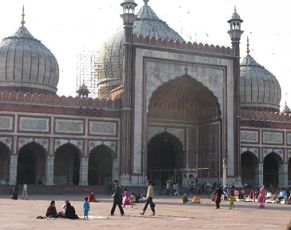
Jama Masjid
But taking off our shoes was only part of what they required. They also gave us a gown to wear over our street clothes. Inside the complex, children played and ran around in the plaza, and adults walked around in gowns. The courtyard seemed like a vast, paved urban park without trees and greenery. Aside from the gowns, it could have been anywhere.
The Jama Masjid is like other mosques we have seen; it is a large space with the women’s quarter separated upstairs. The mosque was completed in the sixteenth century in the old city. The huge mosque in Casablanca, the Hassan II, is like this one, except it has no walls around the large plaza outside and was built recently (finished in 1993). I did not get the religious vibes here that I felt visiting the Cathedral in Santiago de Compostela, perhaps because I am a Catholic and not a Muslim. We left the mosque, and I found my shoes, which I had left outside.
Following our visit to Jama Masjid, Shyaam guided us to Sheeshganj Gurudwara, one of Delhi’s nine historic Sikh temples (the name means “gateway to the guru” in Punjabi). Unlike the mosque, worshippers, women, and men gathered together on the floor in the principal room. As part of the temple’s mission, a women’s auxiliary made naan bread in a small side room to feed people experiencing poverty. They were working quietly, without speaking, a welcome respite from the hustle and bustle outside. They invited Kathy to sit on the floor and join them in making naan. She did it for a while to learn how to make naan, which was more challenging than it looked.
Leaving the Gurudwara, we took Delhi’s spotless subway to Connaught Place, the center of New Delhi. Shyaam escorted us onto the subway train, gave us directions on how to return to our hotel using the subway, and left us to explore. Connaught Place differed from Old Delhi. It was a large circular park with benches on a grassy field. Seven major roads radiated from the perimeter into the urban fabric of New Delhi. Its street-level stores and mid-rise office buildings around the circle reminded me of North American cities. Unlike in Old Delhi, the streets were uncrowded, and the stores were spacious.
Feeling confident in our navigational abilities, we took the subway back to our hotel. I found the subway extremely clean, although crowded. Upon entering a station, all passengers underwent a security check similar to those in airports: a metal detector check and a baggage check. They allowed no food or drink. This rule and its enforcement ensured cleanliness. It was impressive. We got off at the right subway stop; however, with no idea of the geography and, I guess, not having paid enough attention to our surroundings when Shyaam had accompanied us downtown, we had no idea whether to go left or right when we got off and stood there like the lost tourists we were. Luckily, many Delhi residents speak English, and a very kind man helped us find our hotel. This gentleman’s helpfulness, in retrospect, did not surprise us, as we have found in our travels that Indians are friendly people.
 andrasthehun.ca