Boldt Castle Visit: History and Architecture Unveiled

October 22, 2025

October 11. We played tourists today. Although we live just an hour and a half’s drive from Boldt Castle, we had never visited it until now. I’ve heard of the castle, of course, but it’s located on Heart Island, in the Thousand Islands region of New York State, on the St. Lawrence River. Visiting from Canada requires a passport, and since we don’t carry our passports with us every day, we never thought about making the trip.

One can visit the castle from Alexandria Bay in New York State or from Canada, with ferries departing from Gananoque and Rockport, Ontario. We decided to go from Rockport to save time, as driving to Alexandria Bay takes longer.

Upon arriving in Rockport, we noticed eight large tour buses. To my surprise, many tourists from China started disembarking. A local who was familiar with the area explained that Chinese workers are often rewarded with tours to Canada, and many of them visit Montreal, or Toronto, making a side trip to Rockport on their way to Niagara Falls. We also encountered other visitors in the parking area, including a couple from Toronto who were making the long drive back home the same day. We met another couple from Pennsylvania, who decided to sightsee in Canada before visiting the castle. I hadn’t realized how popular the castle is as a tourist attraction. A guide told me that five hundred to two thousand people visit the castle each day.

The boat trip to Heart Island takes about half an hour and passes by some extravagant cottages that resemble large houses more than typical summer homes. Upon landing on Heart Island, we went through U.S. border control, which took a while due to the long lineup of visitors. After we cleared the U.S. border, where they took a photo of us without hats and with our glasses off, we had a couple of hours to explore the island and the castle. Then, we returned to the dock for our trip back.
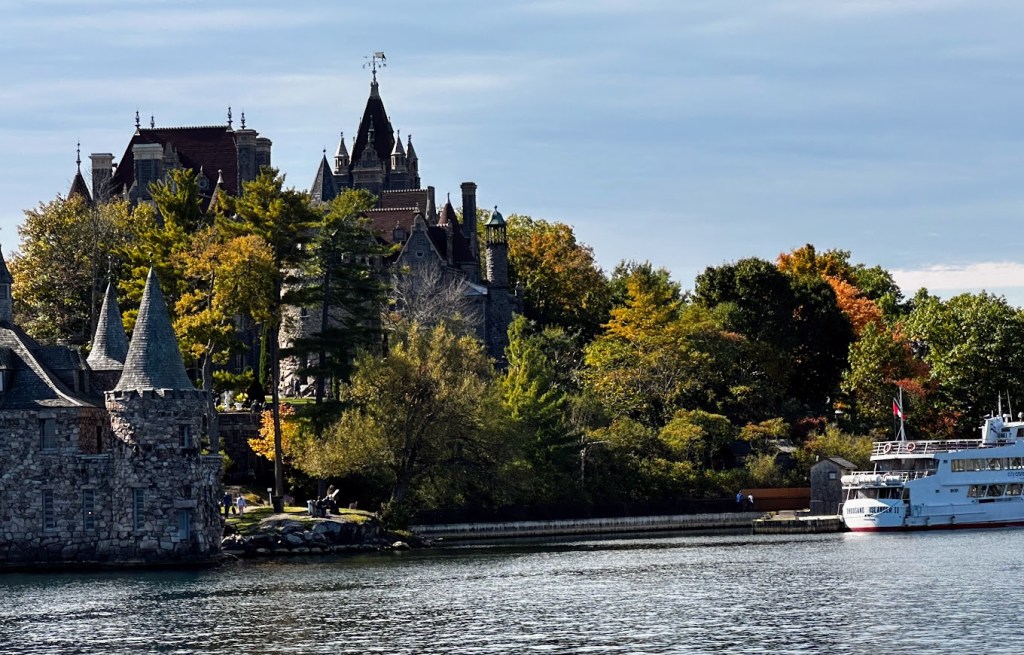
The view from the ferry

As we approached the castle, we saw a wedding on the front lawn and were asked to leave by the organizers. Fortunately, the castle was open, so we explored the large central hall and the enormous dining room before heading upstairs to see the bedrooms. The castle has a total of one hundred and twenty rooms.

The main hall

On the second floor, we watched a short film about the history of George Boldt and the castle. George Boldt emigrated from Prussia to the US at the age of thirteen. He started working in the kitchen of a hotel in Philadelphia and quickly rose through the ranks to manage the hotel at a young age. He became the manager of New York’s Waldorf Hotel and merged it with the Astoria Hotel across the street, becoming the well-known Waldorf Astoria Hotel.

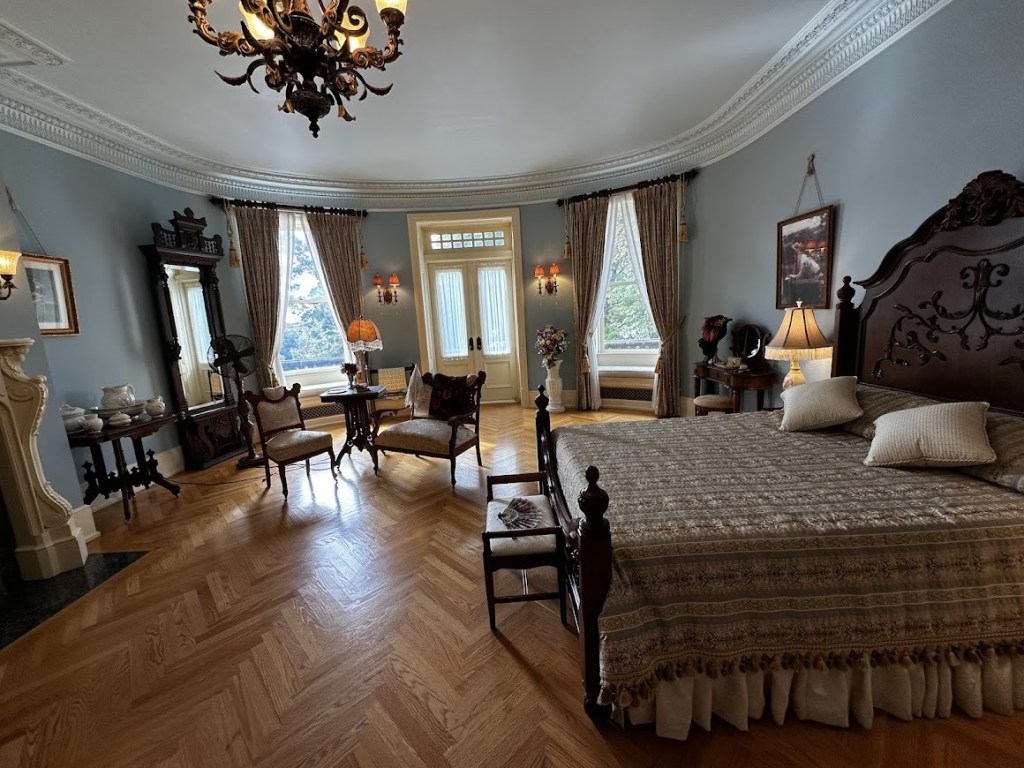
The dining room and a bedroom

As part of his heritage, Boldt is credited with popularizing the “Thousand Island” salad dressing in his hotel. The name originated in the Thousand Islands region of upstate New York, and its original version was made with mayonnaise, ketchup, and pickles. He also created the Waldorf salad, a classic American dish made with diced apples, celery, and mayonnaise.

The Boldt family spent their summers in upstate New York, where George Boldt decided to build a castle on Heart Island for his wife. He was going to give the castle to her on Valentine’s Day. The architecture resembles a Rhineland castle. Construction began at the turn of the century. However, in 1904, tragedy struck when George’s wife passed away unexpectedly. He called off the construction and laid off the three hundred workers who had been building the castle. George never returned to the island, and the castle remained untouched for seventy-three years, falling into a ramshackle state. In 1977, the Thousand Islands Bridge Authority took over the property and invested millions of dollars in its rehabilitation, preserving it for public enjoyment.

Also on the second floor, we saw the rehabilitated bedrooms decorated in period style, belonging to George, his wife, and their children. The floors above have not yet been fully renovated; they currently hold architectural drawings and additional information about the castle.

The garden is also worth visiting, featuring an Italian garden and professionally landscaped grounds with benches. We sat on one of the benches to enjoy our lunch, grateful for a moment of rest after climbing the stairs. It’s important to note that the ceiling heights in the castle are much higher than the typical eight-foot ceilings found in residential homes; climbing four floors felt more like going up six to eight floors in a standard building today.

On the return ferry trip, I bought a cold drink from the bar, which was refreshing and helped me process everything I had seen. If you have visited castles in Europe, this one may not impress you much. However, North America has very few buildings like this one, the Biltmore Estate in Asheville, NC, or Hearst Castle in San Simeon, CA. Visiting this Castle is certainly educational, especially for children. It is also steeped in history and serves as an essential example of the architectural style built during the Gilded Age. I recommend it as a great family outing on a sunny day.

Climate Change in Fifty Years

August 2, 2024

While drilling a tooth in my mouth, the dentist asked me if I thought it was warmer in Ottawa now than a decade ago. Once he pulled out the drill from my mouth and my tongue got free to speak, I said yes. I said absolutely; this area is becoming a retirement community with a balmier climate that has superseded the cold winters. We now have longer, warmer summers and shorter, more tolerable winters.

The impact of climate change on winter sports is undeniable. The once long and enjoyable cross-country skiing season has been noticeably shortened. On the other hand, urban walking in winter has improved. With less snow, we can now stroll around town all winter, often with no snow on the ground.

But let me go back to the winter of 1974 when Ottawa’s average January temperature was 12 degrees Fahrenheit. In contrast, Ottawa’s average January temperature in 2024 was 21 degrees Fahrenheit. This is a significant upward move that has been gradual in my memory. The last few years have been mild and quite manageable, wearing light winter jackets.

Another example of the gradual warming is the number of days the Canal has been open for skating over the years. Dubbed the longest skating rink in the world, the Canal opened for skating in 1972 and was open for ninety days; the temperature was so cold that the ice on the Canal was three feet deep, the standard used for safe skating. It was open for twelve days in 2024 and never opened in 2023.

Leaving the dentist’s office, I met my friend, who explained that we have climate change, but he does not believe we have “global warming.” He agreed that climate change is real; this may be the hottest month in Ottawa, with daily temperatures in the nineties. He questions climate science and quotes periods when we have had warming and cooling over the last thousands of years.

He said Wade Davis’s chapter in his just-published book Beneath the Nature of Things provided the best and most balanced description of the climate issue he had ever read. Davis is a Professor of Anthropology at the University of British Columbia. In his essay, he provides a brief history of the climate change movement from its beginning in 1972 at the Copenhagen Conference.

Davis describes the cult-like followers of the climate crisis, including Greta Thunberg. He also mentions Steve Koonin (the science advisor to President Obama) and those who, although agreeing that the planet is in serious trouble embracing the carbon economy, believe technology will help solve the issue. There are also geopolitical issues: the South is asking for reparations; the North has had the time to create the problem while developing its economy and now asks the South to forego development based on the carbon economy. That does not seem fair. 

Davis intersperses his essay with fascinating facts, for example China approving the opening of 180 coal mines yearly and airline companies having 12,000 airplanes on order. These are examples of how these initiatives will increase rather than decrease the carbon economy. Also, 80 % of India has yet to fly, and sooner or later, all these people would want to experience flying, adding to the amount of carbon dioxide in the air.

The answer: Davis believes in setting action plans instead of target reduction plans; to date, the twenty-eight climate conferences have come up with watery plans, sometimes using misleading data, for example when the NATO countries came up with a target of 24% reduction when they had already achieved 12% of it by letting the ex-Soviet satellite countries join NATO.

Reading Davis’s essay made me wonder if I have ever done anything to reduce my carbon footprint. I belong to the group of people who do not feel the urgency of acting on a doomsday scenario that happens in decades. Polls show that although many believe in the danger of global warming, they are unwilling to act on it since it happens in the future.

Our new car is a hybrid EV. Did we get it because it is environmentally better than a carbon-fueled car? No, it was an economic decision: the mileage is much better than in a fully carbon-fueled car. We have not reduceed our travels to visit family and friends by air or automobile. And we have not downsized to save on heating fuel and AC. Should we?

Many factors influence the decisions to reduce our carbon footprint. The first one is to be convinced that the doomsday scenarios are real. But I have not had the experience that would convince me that we are on the threshold of a crisis.

If I travelled in an area with industrial pollution and massive car traffic resulting in hazy weather, I would put higher priority on solving air pollution resulting from the carbon economy. But that is not my recent experience.

Driving from Pittsburgh, PA, to Durham, NC, via West Virginia, we have seen vast expanses of beautiful open space with rolling hills. We have not seen any air pollution. We smelled fresh air. We also flew from Ottawa to Vancouver a few weeks ago and observed the vast lands underneath with no population. There is crowding with car pollution along parts of the East and West coasts, but most of the country in between is empty. So, I am not inclined to believe we have a climate problem based on my experience. I know there has been a gradual warming in the Ottawa area over the last fifty years. Beyond that, I have a minimal understanding of the future.

My Questions for the Canadian Immigration Minister

November 5, 2022

The Minister announced yesterday that Canada will welcome 500,000 immigrants annually. He said the country needs to move up immigration targets because of the low fertility rate and a million vacant jobs in Canada. But, Mr. Minister, have you fully considered the costs of a sudden surge in immigration, and the impacts on healthcare and housing in Canada?

Canada used to welcome a quarter million immigrants annually, ramping up to 300,000 recently. The number jumped to over 400,000 in 2001 and is likely to approach 500,000 this year.

Immigration policy in Canada has evolved. Initially, immigrants were invited in the 18th century to colonize the west, coming mostly from the British Isles. Central Europeans came early in the 20th century. People coming to work in Canada created the “economic class” of immigrants, and their families followed them (called the “family reunification” class of people). The “refugee” class of people was created under Prime Minister Diefenbaker, who welcomed 37,500 Hungarian refugees escaping their country after the 1956 Hungarian revolution. Sixty percent of immigrants today fall into the “economic” class. India is the source of 32% of today’s immigrants, followed by China at 8%.

Besides economic development, demographics have become a new policy issue for Canada because of our low fertility rate of 1.5%, the replacement rate is 2.1%. So, the question comes to mind: have we tried to influence fertility rates? Many countries have tried it with limited success (Russia, and France, for example). Changing behavior is difficult, so let’s bring more people into the country to boost our population.

But the devil is in the details. Of the two major sources of immigrants to Canada today, India’s fertility rate was 2.1% in 2021 and China’s 1.7%. If immigrants from these two countries continue to follow their culture, they may not help with Canadian fertility rates. But would this flow of immigrants help with the economy?

A target group for the Minister is the science, technology, engineering, and math people (STEM). Yes, we have a million vacant jobs, but most are in the service industries, the hospitality and retail industries, and not in STEM. So this group of immigrants may not help fill the vacant jobs we have in Canada, especially when technology people are being laid off these days (Amazon, Apple, Facebook, Twitter).

A related question I have for the Minister is: what do we do with the one million unemployed people in Canada and another half million people who stopped looking for work? We have one and one-half million people who could be employed. Retraining may make them employable. It may not be in the Immigration Minister’s mandate to solve labor shortages via retraining, but it begs the question: should we look at the unemployed and the stay-at-home people for filling vacant positions in Canada before filling these jobs with immigrants?

And the Minister has not talked about the cost of immigration, except for the benefits to the GDP and the income taxes immigrants will pay. But clearly, immigrants need services like healthcare and housing, provided by lower levels of government. We, the taxpayers, pay all government taxes – federal, provincial and local – so perhaps it is time to reflect on the costs of immigration.

At a time when healthcare is already breaking at the seams with doctors’ shortages and nurses retiring, an increase in immigration will put an additional load on the system. (Six million people in Canada do not have a family doctor. Some emergency rooms have closed due to a lack of nursing staff). You say that, of course, we should target doctors and nurses in the immigration program. Makes sense. But do you realize that both professions require certification by relevant authorities and the reality in Canada is that foreign doctors and nurses must qualify before they can practice?

For example, I had a technician perform an ”ultrasound” procedure on me and I found out that she was a medical doctor from Belarus and took all the Canadian exams to become a doctor but failed to get residency in a hospital required for certification and was forced to take a technician’s job.

Yes, Mr. Minister, we have a supply problem: we need more doctors and nurses and immigration will not provide a quick fix because of certification barriers.

And immigrants need housing. On average, 200,000 housing units are built in Canada annually. The half million immigrants coming to Canada each year could use a few hundred thousand units and drive-up housing prices, especially given the present housing shortage (for example, the Premier of Ontario recently announced a sweeping housing plan to ease the shortage of housing).

Preserving and increasing the value of current homeowners’ units may be good for the homeowners, but difficult for young Canadians who would like to get into the housing market. Has the Minister thought through how the half million immigrants coming into the country each year impact housing markets?

And my questions to the Minister would not be complete without asking about “absorption rates” for immigrants in Canada. Absorption refers to the ease with which immigrants assimilate or integrate into Canadian society: get a job, acquire housing, have their children in school, and become a part of their local community.

Ethnic groups like to settle near each other for comfort. When a large group of immigrants settles in an area – that often happens – ghettos may result and integration into Canadian society may take the back seat. Has the Minister studied how many immigrants can Canada absorb annually?

There are costly impacts on education and social services at the local level when immigrants arrive. Teaching the official languages of Canada to immigrants is a significant cost for school boards. For example, Quebec has 23% of Canada’s population and could take up to 117,000 of the 500,000 immigrants, but the Premier said their capacity to teach the French language is limited to 50,000 people annually. Has the Minister discussed how many immigrants each province would take?

I am for immigration; I was an immigrant myself and found my journey to assimilate into Canadian society has been challenging but tremendously satisfying (it never stops). But I ask the Minister whether he has thought about the impact immigrants will have on our healthcare system, our housing situation today, and our experience with integrating immigrants successfully into our society when suddenly we’ll receive a half million newcomers each year.