We travel not just for leisure, but for discovery. At a recent lunch, friends talked about the journeys they hope to take before age or health makes such trips impossible. This made me wonder: why does traveling hold such appeal? I am not thinking of holidays or beach escapes, but of trips to countries unknown to us—adventures I call discovery trips.
Discovery trips offer a sense of freedom. Packing minimally—a suitcase and a backpack for daily excursions, I leave behind daily commitments. Far from home, it feels liberating not to worry about bills or routine chores like taking out the garbage. In unfamiliar countries, every day offers discovery: meeting new people, sampling local dishes, observing architecture, and learning to navigate local buses. Conversations with locals often become both enjoyable and necessary as we find our way.
Travel also offers an education. Seeing things with new eyes becomes inevitable. The visible poverty in India, for example, places North America’s general wellness into sharp relief. Comparing Ottawa’s traffic to maneuvering through downtown Dhaka, Bangladesh, showed me how minor our own traffic woes are in comparison.
Before these trips, I research our destination. After returning, I expand on what I’ve learned. I once knew about the Indian caste system in theory, but witnessing it firsthand deepened my understanding of its implications.
The memory of an incident at Kolkata’s airport remains vivid. A well-dressed man suddenly placed his suitcases in front of ours as we waited in a long line for x-ray inspection. My temper flared, and I pushed his suitcase aside, firmly telling him we had arrived much earlier than he had. He made no argument—perhaps because we were foreigners. That experience prompted me to return home and delve into the history and evolution of India’s caste system.
There was also the night our hosts in Dhaka took us to their favorite restaurant. When they ordered goat brains during a period of mad cow disease in England, curiosity mingled with courtesy. We ate. The dish resembled scrambled eggs, though spiced differently.
Each trip required us to set aside our Canadian routines. We engaged all our senses with local culture, cuisine, and people. I took no notes at the time, yet I now realize that relying on memory allowed me to reflect and better recall details that differ from our own way of life.
He said Rajasthan. A young man from Rajasthan offered landscaping services at my door. A wonderful place that we visited a few years ago with a guide, Shyaam. The memories that popped up overwhelmed me and I engaged in a discussion with the fellow at the door about the desert and the havelis in his home state. One highlight of our trip was Jaipur.
Jaipur, the capital of Rajasthan, is a city with a population exceeding two million. The drive from Agra took more than six hours. On the way, we stopped to have a thali lunch. They served it on a large metal plate (they also call the plate a thali), on which they arranged many small dishes around the edge, filled with ingredients such as yogurt, dal, vegetables, and chutney. Rice and chapati went in the middle of the thali dish. Eating was done with your fingers; these highway restaurants had a sink at one end of the room where you washed your hands before and after eating. Shyaam explained that the idea behind thali was to offer six different flavors: sweet, salt, bitter, sour, astringent, and spicy on one plate. According to Indian food customs, a proper meal should perfectly balance all these flavors. I was unsure what perfect balance meant among flavors, but we enjoyed the meal and improved our eating skills with our fingers.
The highlight of our stay in Jaipur was seeing and experiencing a Bollywood movie at the Raj Mandir Cinema. The movie house was a large circular building similar to an opera house, where there must have been at least one thousand seats, all occupied, quite a contrast to the smaller theaters we are used to in Canada, which are hardly ever filled.
The film had a cute and typical storyline: a boy falls in love with a girl who rejects him. Both the boy’s and the girl’s families reject romance, and the boy loses sleep, his job, and upsets his family. There are fights between the boy and the girl’s friends in various locations where the boy gets beaten up, but his disheveled hair and clothing are still picture-worthy. The girl’s and the boy’s relatives try to stop the relationship. Then the girl makes a telephone call, after which she disappears. Boy tracks down the baddies and rescues the girl who cries. There were singing and dancing events in various locations, but ultimately, the girl falls for the boy, and the relatives decide the boy is not so bad. The story ends with a large wedding with lots of singing and dancing. This storyline is, apparently, quite typical of Bollywood movies.
What I found more interesting than the movie was how the audience reacted to the scenes with clapping, singing, approving comments, and a loud reception. There was cheering when the boy enticed the girl and booing when the villains lost fistfights. At the wedding at the movie’s end, the entire audience was on their feet, cheering. It was a genuine experience in audience participation and quite a contrast with what I am familiar with, where even people with a cough are shushed by the other moviegoers.
We stayed at the Bissau Palace. The descendants of the royal family ran the hotel/palace (and lived on-site), and the hotel was one of the very few in Jaipur recognized by Indian authorities as a genuine Heritage Hotel. Set back from the iron gates within a village-like compound, it featured a temple, shops and a sizeable pool. The exterior of this century-old building needed some paint and maintenance, but the ramshackle look added to the charm; in fact, renovations would ruin the vibe. But our room was faultless and spotless, featuring hand-painted ceilings, lead-light windows (decorative glass supported by lead cames), and old-fashioned wooden furniture. And the food was native Indian to our liking.
Shyaam, our guide, had reserved a room at the Lake Pichola Hotel in Udaipur, Rajasthan. This opulent heritage hotel, formerly Piplia Haveli, was built in the eighteenth century as a private residence for the Jagirdars (nobility) of Thikana Piplia. The hotel’s corridors were adorned with royalty images, illustrating Udaipur’s rich history and property. The owner of the Lake Pichola Hotel is a descendant of the rulers of Udaipur and has taken over the management of this heritage hotel.
Our large, comfortable room faced Lake Pichola and opened onto a balcony with windows all around. The balcony was furnished only with sumptuous pillows, reminiscent of harem rooms we had seen in pictures; it looked incredibly inviting after a long drive. We relaxed on the cushions, enjoying the beautiful views of the lake, the Udaipur Palace across the water, and the Oberoi Hotel, where James Bond’s “Octopussy” was filmed. As we sipped our drinks, we watched women at the lakeside washing laundry, a stark reminder of the contrasts between wealth and poverty in India.
According to Oxfam, seventy-three percent of the wealth generated in 2017 went to the top one percent of the population. The number of billionaires increased from nine in 2000 to over one hundred in 2017. I reflected on these numbers, but seeing poor people washing clothes in the lake opened my eyes.
We met our guide, Shyaam, in the hotel dining room, where authentic Indian food was served. By then, we were running low on rupees, and many of the smaller stores we visited either did not accept dollars or charged exchange rates that seemed exorbitant. We asked Shyaam where we could exchange our U.S. dollars for rupees. Although he did not mention any ATMs or banks, he suggested a contact of his who offered money exchange services. It sounded dubious, but he claimed we would get the best exchange rate from this contact. We decided to take a chance on his offer, partly because we trusted Shyaam, who worked with the travel company Intrepid, and partly because we didn’t see any other options.).
The next day, we walked up the street to an office address and entered a small room on the main floor. Some people were working in the back office. We sat in the waiting room, hoping that Shyaam had indeed arranged a meeting with his contact, the money changer. We waited, uncertain of what to expect, until a dapper, well-dressed gentleman in a suit and tie, carrying a briefcase, entered the room. He asked if we were Shyaam’s clients, and when we confirmed that we were, he set down his briefcase. He then inquired how much money we wanted to convert and informed us of the exchange rate he offered. It was a better rate than the banks charged, and our only concern was whether his money was legitimate or counterfeit.
The money changer seemed honest, so we decided to exchange some currency, although not as much as we had initially planned, to be cautious in case the bills were counterfeit. He examined our dollars individually, selecting only the ones in excellent condition without tears. After calculating the equivalent amount in rupees, he opened his briefcase filled with rupees, counted out a stack for us, and handed it over. There was no official receipt, and he left immediately after the transaction. I remain uncertain about whether this market activity was legitimate in Udaipur. I wondered if it might have been part of a black market; India likely has various money exchange options. Another thought that crossed my mind was whether Shyaam was involved in this exchange—whether he was assisting clients as a tour guide for a major travel company or if he was part of the transaction and receiving payoffs. However, we had no issues with the money the money changer provided us.
With our newly acquired rupees, we walked toward the center of Udaipur, climbing a hill in search of the famous miniature paintings, sized 4″ x 12″. This art form originated in the sixteenth century, with artists creating these paintings as memoirs for kings, capturing important historical events. The paintings depict vignettes of a king’s life from the past, and even today, they are created and sold as decorative art.
The artists use a meticulous process to manufacture pigments and colors from scratch. We stopped at several stores to admire these paintings. Unable to resist, we decided to purchase a few as souvenirs. They were beautiful and unique to Udaipur and easy to transport due to their small size. Although we could have bought them unframed for easier transport, we opted for framed pieces, which cost much less than a frame at home.
As we left the store, we spotted an elephant coming up the hill toward us. A mahout was riding on the elephant, sitting more than ten feet off the ground. I quickly grabbed my camera to take a picture. However, as soon as the mahout noticed me, he began protesting and waved both hands, trying to stop me from taking the shot. He made the international gesture of asking for money by rubbing his fingers together with his palm facing upwards. Even if I had wanted to give him money, I couldn’t have reached him, and it was clear he wasn’t planning to stop the elephant or dismount.
Suddenly, the elephant started to pee, creating a river streaming down the asphalt. I couldn’t believe the volume that came out! I felt grateful to be wearing closed-toe sandals at that moment. I noticed some tourists walking behind the elephant, trying to capture the scene on camera, but maintaining a safe distance to avoid the chaos. All of them were wearing open-toed sandals. I felt sorry for them but was reminded once again why open-toed footwear isn’t the best choice for sightseeing.
Our wanderings in Udaipur took us to the City Palace, an imposing structure with a 250-meter frontage and several entrances. This multi-level complex stands 30 meters high and is beautifully situated on a hilltop. The upper floors overlook Lake Pichola, providing excellent views.
The palace was constructed entirely from marble and granite, with construction beginning in 1576 and continuing for four centuries. It is an interconnected complex made up of various palaces built by successive dynasties.
I remember how we had to navigate many staircases to explore the building, which left us feeling quite exhausted. However, it was a remarkable historical and cultural journey. We admired stunning wall paintings, intricate murals, exquisite marble work, detailed inlay work, and remarkable architectural features, including cupolas, domes, towers, and balconies.
After a few weeks on the tour, I felt overwhelmed by the many palaces and forts I had seen. By this point, I preferred conversing with local people rather than admiring centuries-old artifacts, no matter how beautiful or historically significant they were. I found discussions with tuk-tuk drivers about their families fascinating, even though many did not speak English. While I still appreciated history, I realized traveling became much more fulfilling when interacting with the local residents.
While driving through the Thar Desert, the temperature soared into the upper 40s Celsius. Despite the heat during our travels in Rajasthan, our trip was filled with unique experiences, including an Ayurvedic massage, a camel ride in the desert, and accommodation in a Maharaja’s palace.
Many Maharajas lost their wealth and status after India gained independence, forcing them to find new ways to make a living. Many were left with nothing but their palaces, which they transformed into hotels. Our room in one of these palaces had an authentic atmosphere characterized by heavy curtains to keep the heat and noise out, aging period furniture, and a slightly musty smell. It was huge by North American standards. The luxurious palace made us feel important while we stayed there.
We had arranged for an Ayurvedic massage, advertised in the palace’s lobby, to be performed in our hotel room. Ayurveda, a practice that has been around for over five thousand years, focuses on balancing the body and mind. Practitioners use hot oils to promote healing and restore imbalances, and we were eager to experience it.
Two young therapists arrived—one woman and one man. Their English was limited, but they instructed me to lie on one bed and undress to my shorts, while Kathy undressed to her bra and shorts on the other bed. The therapists, dressed in business attire, covered our faces with towels before opening massive suitcases filled with various oils.
The room was quiet, and the warm oils, infused with fragrant herbs, helped us relax. I remembered a massage I experienced in Thailand, which ended with painful toe pulls. In contrast, the Ayurvedic massage was incredibly soothing.
The therapists advised to remain on the bed after the massage to allow the oils to seep into our skin until they dried and removed toxins. We had no trouble relaxing further; we were half-asleep by that point. After an hour of blissful peace, we got up to explore Jaisalmer (population 65,000 in 2011, 90% Hindu).
Walking around the city was challenging due to the narrow streets and roaming cows. At one point, a group of cows blocked Kathy as she tried to navigate her way. Many towns in India have laws against cows wandering freely, but Jaisalmer is an exception, marking our first encounter with numerous cows meandering about. (Cows are considered sacred by Hindus).
It was hard not to feel sorry for the cows, many of whom appeared half-starved and abandoned. I learned that volunteer veterinarian groups from overseas come to India to trim the cows’ hooves, allowing them to walk more comfortably. We often saw people feeding the cows before having their meals in the mornings. In the evenings, the cows usually rested or slept at the edges of the streets, having nowhere else to go.
On our way back to the hotel, we met an Indian man from Britain who expressed great disappointment in visiting his hometown. Contrary to his childhood experience, he found Jaisalmer to be backward and dirty. While we accepted what we saw as the norm, he wished the local government had done a better job in the city.
Our overnight camel safari in the desert began the following day. Due to the camels’ unique characteristics, we were advised to wear long pants to prevent irritation from their swaying and straw-like hair. Sunglasses and face coverings were also recommended in case of a sandstorm.
The safari started with a challenge: how do you get on a camel? We learned that when the camel is seated on all fours, one should climb up onto the saddle attached to its hump and lean back to avoid falling forward when the camel stands up, starting on its hind legs.
We began our camel trip on the outskirts of Jaisalmer, where we felt strange riding a camel. The roads were busy with motorcycles, trucks, bicycles, and two-wheeled camel carts with used airplane tires. People used camels as work animals. I initially thought I needed to control the camel in the traffic, but I quickly learned that this was not the case—camels listen only to their masters. In addition, our camels seemed to know exactly where to go.
Our leader walked beside his camel until we left the town and entered the desert. My camel followed the guide, a Raika tribesman. Kathy rode behind me, followed by two tribesmen and three additional camels carrying our gear.
The desert gradually enveloped us, and we continued riding in the heat until the leader suddenly stopped and unfolded a small prayer rug for himself to kneel and pray on. We also dismounted and stretched our legs to relieve any stiffness. Resuming the trip, we knew how to mount the camels.
At our camp, a couple of tribesmen set up an open-front tent equipped with cots and a small toilet tent for us. They also erected a collapsible table with chairs while the cook prepared our meals a short distance from our camp.
The temperature dropped significantly after sunset. The cook prepared mouth-watering curries for us, and we finished our meal with hot chai tea infused with cloves, cinnamon, and cardamom. A spectacular view of millions of stars in the sky appeared when darkness had fully descended.
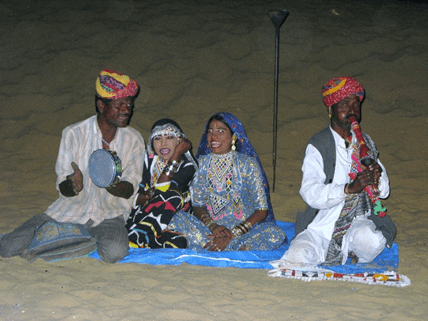
Suddenly, out of nowhere, a Gypsy family appeared with musical instruments. They began to play music next to our campfire, which was fueled by camel dung. The young girls started dancing in flowing, gold-braided dresses while their parents played unique musical instruments I had never seen before. The entire Gypsy family was dressed in colorful embroidered shirts and skirts, with the father wearing a turban on his head.
After the performance, we relaxed on our cots, gazing at the countless stars outside our open tent. I found myself wondering if the Gypsies were simply nomadic people who happened to see us in the desert or if, more likely, the organizers of our tour had arranged for them to perform for us.
Before drifting off to sleep, I thought about how majestic the camels were, with their slow, ambling gait. I also reflected on the Raikas, a local tribe in Rajasthan, who are actively working to protect the diminishing number of camels. Thanks to their advocacy, the government declared the camel the state animal of Rajasthan in 2014.
We flew to Delhi, where we spent one day—quite an introduction to India! Our hotel was outside of Delhi’s center, accessible by subway. Shyaam, our guide, led us on a subway journey to Old Delhi’s historical sites and bustling market. We followed Shyaam through the crowded streets. The heat made me wipe the sweat from my face. It felt as if we walked a long way, only to discover that the distance covered was only a few blocks.
Rubbernecking to see the small stores and fighting the jostle of people was tiresome. After a while, we were ready for a snack and looked longingly at the street vendors with their steaming foods. Shyaam cautioned us about buying from a street vendor and suggested that we wait for the next round of freshly cooked food to be ready to eat rather than take the already prepared food in bowls on a counter along the street full of flies munching on the food. So we waited ten minutes for the next round of cooking. It was worth the wait—it was delicious; I think we had chunks of lamb with spices I was unfamiliar with.
The atmosphere in that part of town differed from what I have ever experienced. Besides the teeming crowds, with the temperature hovering in the upper thirties Celsius, the smell of spices permeating the air was powerful. In this district, spice store after spice store with hundreds of spices competed for attention with fancy exhibit boxes containing almost every spice imaginable: mustard seeds, coriander, garam masala, and others. A dispute unexpectedly flared up outside a spice stand between a customer and the store owner. Almost immediately, a large crowd gathered, and yelling started. We were made acutely aware of our vulnerability and the potential for sudden violence by the crowd’s sudden outburst and rapid gathering. I told Kathy we should just move on and leave the crowded sidewalk before violence broke out.
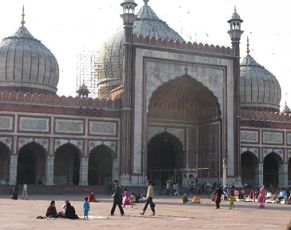
Among the sites Shyaam took us was the Jama Masjid, the oldest mosque in India. A wall surrounded the entire mosque complex, with a football-field-sized plaza in front of the mosque, large enough to hold 25,000 people. At the entrance gate, they directed us to take off our shoes and leave them on the steps leading up to the mosque, next to hundreds of others’ shoes on the steps. I was wearing my good walking shoes and was nervous about leaving them on the steps, but we had no choice; I thought of someone just coming out of the mosque and taking my shoes by accident.
Jama Masjid
But taking off our shoes was only part of what they required. They also gave us a gown to wear over our street clothes. Inside the complex, children played and ran around in the plaza, and adults walked around in gowns. The courtyard seemed like a vast, paved urban park without trees and greenery. Aside from the gowns, it could have been anywhere.
The Jama Masjid is like other mosques we have seen; it is a large space with the women’s quarter separated upstairs. The mosque was completed in the sixteenth century in the old city. The huge mosque in Casablanca, the Hassan II, is like this one, except it has no walls around the large plaza outside and was built recently (finished in 1993). I did not get the religious vibes here that I felt visiting the Cathedral in Santiago de Compostela, perhaps because I am a Catholic and not a Muslim. We left the mosque, and I found my shoes, which I had left outside.
Following our visit to Jama Masjid, Shyaam guided us to Sheeshganj Gurudwara, one of Delhi’s nine historic Sikh temples (the name means “gateway to the guru” in Punjabi). Unlike the mosque, worshippers, women, and men gathered together on the floor in the principal room. As part of the temple’s mission, a women’s auxiliary made naan bread in a small side room to feed people experiencing poverty. They were working quietly, without speaking, a welcome respite from the hustle and bustle outside. They invited Kathy to sit on the floor and join them in making naan. She did it for a while to learn how to make naan, which was more challenging than it looked.
Leaving the Gurudwara, we took Delhi’s spotless subway to Connaught Place, the center of New Delhi. Shyaam escorted us onto the subway train, gave us directions on how to return to our hotel using the subway, and left us to explore. Connaught Place differed from Old Delhi. It was a large circular park with benches on a grassy field. Seven major roads radiated from the perimeter into the urban fabric of New Delhi. Its street-level stores and mid-rise office buildings around the circle reminded me of North American cities. Unlike in Old Delhi, the streets were uncrowded, and the stores were spacious.
Feeling confident in our navigational abilities, we took the subway back to our hotel. I found the subway extremely clean, although crowded. Upon entering a station, all passengers underwent a security check similar to those in airports: a metal detector check and a baggage check. They allowed no food or drink. This rule and its enforcement ensured cleanliness. It was impressive. We got off at the right subway stop; however, with no idea of the geography and, I guess, not having paid enough attention to our surroundings when Shyaam had accompanied us downtown, we had no idea whether to go left or right when we got off and stood there like the lost tourists we were. Luckily, many Delhi residents speak English, and a very kind man helped us find our hotel. This gentleman’s helpfulness, in retrospect, did not surprise us, as we have found in our travels that Indians are friendly people.

 andrasthehun.ca