Why Standing Desks Improve Typing and Kit Assembly Experiences

January 27, 2026

The clerk at the reception desk worked standing at an elevated desk for typing. I asked her how she liked standing and typing. I had just bought a desk that moves up and down and adjusts to accommodate both sitting and standing positions. The professional advice is that typing while standing is good for your health and can improve typing speed. Apparently, one is more focused, energized and alert while standing. Blood circulation is also better, and you are likely to lose weight because standing eats up more calories than sitting. At least, that is what I read in the literature and triggered me to buy a stand-up desk.

The receptionist said she enjoyed typing while standing, so I shared my experience buying and assembling a stand-up table kit. The kit arrived with clear instructions for 17 steps, requiring screws plus extras, and perfectly aligned predrilled holes. This was a relief because I’ve struggled with other kits missing parts or with misaligned holes.

As I finished my story, the receptionist shared her own experience. In one of her previous jobs, she had the challenge of reassembling returned products in a furniture department store, often missing pieces.

I could not help but describe an earlier experience I had putting together a kit. It was Christmas time, and we bought one of our young children a large rocking horse that came in a box. On Christmas Eve, and after the children went to bed, I started assembling the rocking horse around midnight. Assisted by drinks and a few hours of struggling with instructions and pieces that either did not fit or were left over, I had the rocking horse assembled. I was ready to move the horse into the living room where the Xmas tree was. To my consternation, the fully built rocking horse was too big to fit through the door! A most unsatisfying experience that led me to swear off ever building another toy. The only available option was to take the horse apart, move it into the living room, and then reassemble it.

Come to think of it, many of my attempts at assembling products that come in large boxes leave me feeling incompetent and frustrated. They take many hours, including reading multi-step instructions in small print, often accompanied by drinks to relieve stress. The last big assembly was a BBQ that took four hours. It took a case of beer with an obliging friend who, luckily, followed instructions, to complete the assembly. In other cases, I studied all the provided pieces before assembling the products intuitively, with varying success.

I am typing this blog standing at my new table, elevated to its highest position. So far, so good. I do not feel tired. I am not sure if I am more focused, energized, or typing faster. Maybe I’m faster, but I am making more grammatical and spelling mistakes. It’s a new experience. Resting my elbows on the table feels comfortable and I think I’ll get used to it.
Exploring the Value of Personal Interaction in Today’s Digital World

January 20, 2026

At the local box store I visited, the young salesperson from Gujarat showed me a slew of laptops and described their capacities. He was very knowledgeable. In the ensuing conversation, I learned that he is a graduate student in engineering and has been seeking a permanent job while pursuing his studies. I prefer to make informed decisions, so I told him I’ll go home and review the computers he recommended online.

On driving home, I stopped at another box store and had a similar experience with another salesperson, another immigrant, this one from Africa. The computer sales personnel in both box stores were immigrants, to my surprise. Many immigrant students pursue studies in science and engineering and support themselves financially by selling technical products.

He showed me several suitable laptops: lightweight, with a terabyte of storage, lots of RAM, and a fast chip. My preferred model was only available as open box, with a 10% discount. I wanted to check online reviews and asked the salesperson to hold the open-box model overnight.

When I returned the next day to buy the model based on the good reviews, the Christmas sale was still on, but the open box model was unavailable. Instead, they found a new one and, after some discussion, offered me the same 10% discount due to their earlier promise.

While waiting to finalize the sale, I noticed a sign advertising the credit card for this box store. According to the ad, you get a 10% discount on your first purchase. Wow! I decided to get another credit card and filled out the paperwork to receive my additional 10% discount on the computer.

I thought about the process of buying a laptop, driving home. No question that I spent hours talking with numerous salespeople, a time-consuming process. But I learned from the conversations, and, more importantly, I enjoyed them. It was satisfying to speak with people rather than scan websites like Amazon and buy a laptop online.

Although a stretch, this experience contrasts with a recent coffee purchase at McDonald’s, where I just went up to the screen to order, then waited, and picked up the coffee at the counter without speaking to anyone. I found it much more satisfying to purchase merchandise by talking with people. But I understand that businesses may prefer cutting out people-to-people communication to streamline the sales process and speed up business transactions.

The other thought that crossed my mind was whether businesses like to cater to retired people who may have time on their hands to study promotions and sales.  They can be selective in their buying habits and are often more demanding customers than younger people with jobs and families.

On reflection, I found talking with people while transacting business was thoroughly satisfying. I wondered whether the trend to simplify business transactions by moving them online would have negative consequences for conversational skills and social interaction (I fail to see the digital world, or what is called social media, as a replacement for face-to-face contact, including Zoom). Remote work is gaining popularity, especially since Covid, and with consumer goods available online, one can stay home and get by without face-to-face interaction with the outside world for months. Would this trend lead to more isolation and loneliness?

Ordering Made Easy: Exploring Architecture and Interior Design

January 13, 2026

I tried to purchase coffee on the order screen at McDonald’s yesterday. After three attempts at pushing the wrong buttons, I got it right. But it took more than twenty screen taps to get my simple order. To start with, choices were “here or takeout”; then pick one item from dozens of food and drink options; then “hot or cold” from numerous drink choices; then coffee size – three options; then what to put in the coffee; and then pay on the screen or at the cashier. I mean, I could have ordered it verbally by saying, “Small black coffee, please.” Four words. No matter. The screen works for all orders, and the more screens there are, the more people can order simultaneously.

I still prefer to speak with someone when ordering; I prefer a social interaction. As a result, I often end up at Starbucks or Tim Hortons, where one must order by speaking with a barista or server.

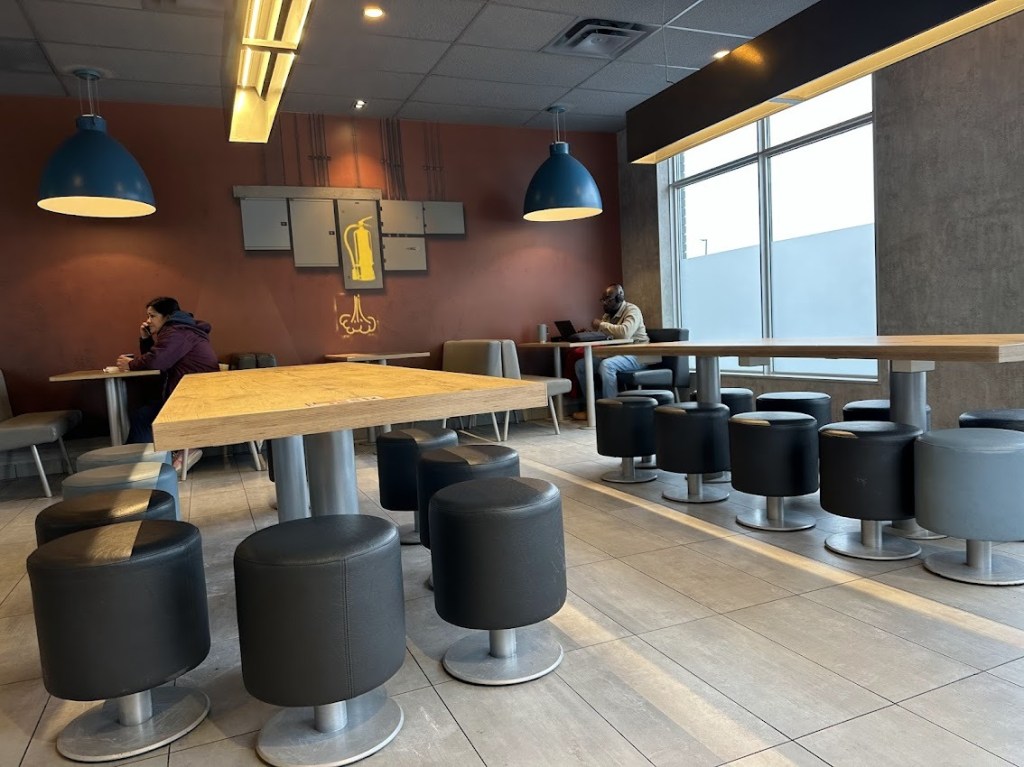
Surprisingly, there were many middle-aged people at this outlet next to Algonquin College in the early afternoon. I expected more students instead. And the people occupied the seats around the perimeter, sitting at tables for two and four, leaving the large communal tables in the middle of the restaurant empty.

Yes, I read that McDonald’s new interior design, called Luna, was developed by an Amsterdam consultant. According to the architect, the design concept encourages socializing, saying hello to people, and facilitating conversations. That is the theory, although I did not see people greeting each other and engaging in conversations.

The Luna design concept features large communal tables that are high and surrounded by barstools, as well as smaller tables around the perimeter. There are 10 or more stools around each large rectangular table. I did not see anyone sitting at these tables. But the furniture design and the colors were pleasing. The walls are painted brown, interspersed with grey accents. According to the designers, it is a subdued atmosphere with no bright colors.

And I did not see a children’s play area, a space I had seen years ago at many McDonald’s outlets. Clearly, McDonald’s moved on to cater to an older clientele. It may be a response to demographic changes, or the older age group may be financially better able to eat there.

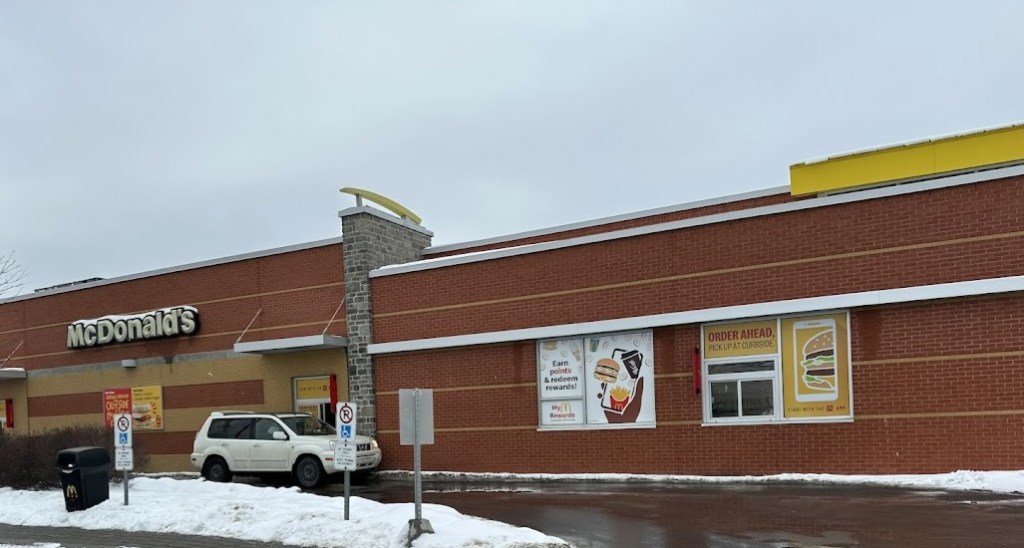
I remember the original McDonald’s, with its huge Golden Arches to catch drivers’ attention on the highway. Then the company decided to blend the architecture into the residential areas, perhaps encouraged by zoning bylaws, coming up with the Mansard roof, which blends into the neighborhood. And now, the buildings seem to be simple rectangles, with the logo still intact and small Golden Arches along the fascia. These buildings could just as easily be office buildings, such as medical or insurance businesses. I saw how easily these McDonald’s structures could be converted into offices should the neighborhood’s demographics change and the outlet lose business.

I like the new interior designs, though not so much the exterior; the buildings are boxes with dull colors. I don’t know how the designers arrived at designing such boring buildings. Did they envision a plain, innocuous look that would correspond to the challenging economic and political conditions of the last few years, combined with the recent Covid pandemic?

However, I find McDonald’s an attractive stop on the highway, as their food quality is consistently good and they have kept their menu items up to date to satisfy regional tastes. For example, they offer sausage gravy in the southern states. I always look for sausage gravy, a favorite of mine, and I had some at a South Carolina McDonald’s that was excellent. Now, I am not commenting on the nutritional value of their food; that is a different issue.

I make stops at McDonald’s whenever I’m traveling on the highway. But it is certainly not equal to home-cooked meals in terms of nutritional value or compared to a comfortable home environment. But boy, is it ever tasty to chomp into a Big Mac with fries, occasionally? Despite the calories and fat!

Navigating Municipal Services: Recycling Dilemmas

January 7, 2026

Do you live in a city with municipal services such as water, sewer, electricity, and waste collection? And if you do, have you ever had trouble with any services? Today was my turn.

This morning, before seven o’clock, I put out the garbage for collection. I won’t bore you with the complicated schedule of what gets picked up when — let’s just say you practically need a college degree to figure out which type of waste goes into which color bin on which day of the week.

So out went the blue bin with glass and plastics, the green bin with compost, and two black garbage bags containing all other garbage except paper, which is collected on alternate weeks. When I stepped outside an hour later, two more black garbage bags had magically appeared beside mine. Someone had the audacity to drop their garbage at my curb.

Normally, that wouldn’t matter, but in their infinite wisdom, the city fathers have decided that we must recycle more and now only pick up three black garbage bags every two weeks. I decided to wait and see whether the collectors would take all four bags. Of course, they didn’t — one bag was left sitting on my driveway.

I was annoyed. I suspected the neighbor across the street, because next to us is a large rental complex with huge open dumpsters, so the tenants wouldn’t need to sneak extra bags onto someone else’s curb. Our immediate neighbors don’t produce much garbage, and we know them well. The couple next door and the small family across the street have even asked us in the past to put out their bins when they’re away. That left, by process of elimination, the neighbors one house down on the opposite side of the street.

My suspicion grew when I remembered that over the weekend, they had four cars in their driveway and another four parked along the curb in front of our house. When I took out my garbage, I also noticed a pile of bins and bags on their driveway. One gets the impression they might be running a B&B out of that house — there are always different cars coming and going, some staying for weeks, others only a few days. I even searched online to see if I could identify the owner or occupants but found nothing.

Frustrated, I picked up the extra bag and placed it squarely in the middle of their driveway. Let them deal with it. When I checked later that night, the bag was gone and a car was parked there instead.

Was I right to return the bag? Should I have knocked on their door to discuss it? I honestly don’t know. I don’t know any of the people living there, and with the constant flow of vehicles, it’s impossible to tell who lives there. Maybe I overreacted — but at the time, it certainly didn’t feel like it.

The lesson to learn is that recycling does work. Once you separate paper, glass, plastics, food and garden trash, there is not much garbage left. So, the next time I find garbage on my driveway I did not place there, I’ll go across the street and try to talk with the residents there about recycling.

Meet New Friends: Dogs as Conversation Starters

January 1, 2026

While visiting my daughter in Williamsburg, VA, I strolled through New Quarter Park, where I met Mike and his canine companion, Leila. The unleashed Leila, an eighty-pound German Shepherd, approached and sniffed my outstretched hand before continuing to investigate the surroundings. Mike explained that Leila, although very affectionate, was not the kind of dog who lounged on his lap or slept in his bed, which, given her size, would overwhelm Mike’s modest build and take over his bed.

Leila actually belongs to Mike’s brother, who lives in a Manhattan apartment and had lent the dog to Mike for a few weeks. The thought of keeping such a large German Shepherd in a downtown New York apartment struck me as challenging, especially since Leila is five years old and needs regular exercise. I found it hard to imagine how someone could care for a dog like her in a constricted space, particularly if she was left alone while her owner was at work.

Mike walks Leila twice a day and buys substantial amount of food to keep her appetite satisfied. Despite these challenges, Mike spoke fondly of her, describing her as very protective. This made me wonder if his brother kept her for safety, but I realized this might be a stereotype image I have of big cities, the neighborhood where his brother lives in New York may be pretty safe.

Leila’s friendly greeting led to an extended conversation with Mike. I learned that Mike grew up in Norfolk, VA, near Williamsburg. After living in various places, he returned to the East Coast and is now happily retired in Williamsburg. His downtown apartment is comfortable and close to amenities and the park, so he can easily walk Leila.

Continuing along the park path, I met three people with two dogs running around them. When they noticed me, they quickly put leashes on their dogs. I assured them that I liked dogs and encouraged them to let the dogs remain loose and invited the dogs for a “sniff introduction.” A black Labrador came over to acknowledge me while the other one paid no attention. The owners shared that during the Covid pandemic, they kept their dogs away from people because most people shooed them away. They also mentioned that not everyone in the park welcomed dogs on the loose and had been asked to leash their pets.

Reflecting on these encounters, it dawned on me how easily dogs initiate and facilitate conversations among people. Confirming my eureka moment, I encountered another dog pulling her owner’s arm out of its socket to get closer to me. She was a middle-aged woman, and rather than watching her struggle to keep the dog from crossing the road, I walked over and explained that I would be comfortable with her pet greeting me. In the ensuing conversation I discovered that she was, in fact, my daughter’s neighbor.

In just a couple of hours, I had three interesting conversations with dog owners, each one initiated by their dogs’ curiosity. The lesson: to meet people, go for a walk and find dog-walkers.