May 29, 2025
Granville Island is a vibrant thirty-five-acre urban district located under the Burrard Bridge in Vancouver. Due to limited parking, we chose to take an Uber to get there. Granville Island is the most visited tourist destination in Canada after Niagara Falls, attracting over ten million visitors each year.
The sandbar that is now Granville Island was a traditional fishing site for the Squamish and Musqueam tribes. The early 1900s saw industry’s expansion into the land, supporting the maritime and lumber industries. Until 1972, hobos lived on the island before the federal government took control. Ron Basford, the minister responsible for the lands, envisioned redeveloping the area while preserving the original buildings and businesses. His vision ultimately grew into a roaring success.
There are no sidewalks here; the planners envisioned a pedestrian district. The streets are narrow, filled with throngs of people moving through the walkways. There are also three thousand people working on the Island. Cars move extremely slowly along the crowded streets. We initially thought a line of vehicles on the main street was a parking lot, but then the cars began to move—it was not a parking lot after all.
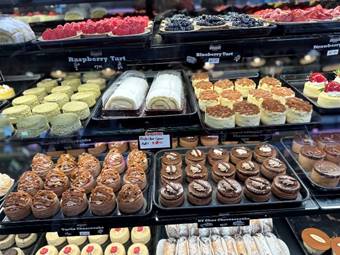
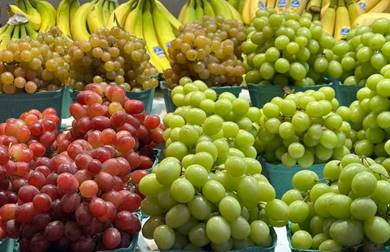
The taxi dropped us off at the Public Market, a large, renovated warehouse filled with a variety of merchants. The market features bakeries, fruit and vegetable stands, butchers, as well as specialty cheese and international food vendors. After noticing a lineup at the BC salmon seller, we decided to purchase some in a freeze-dried bag to take home. Of course, we couldn’t resist getting fresh, sweet cinnamon buns from a local bakery, so we hurried over to a roaster for their exceptional coffee to enjoy with the buns. There was a line at the coffee shop as well. We learned that all fifty merchants in the Public Market are local, and no chain stores are allowed.
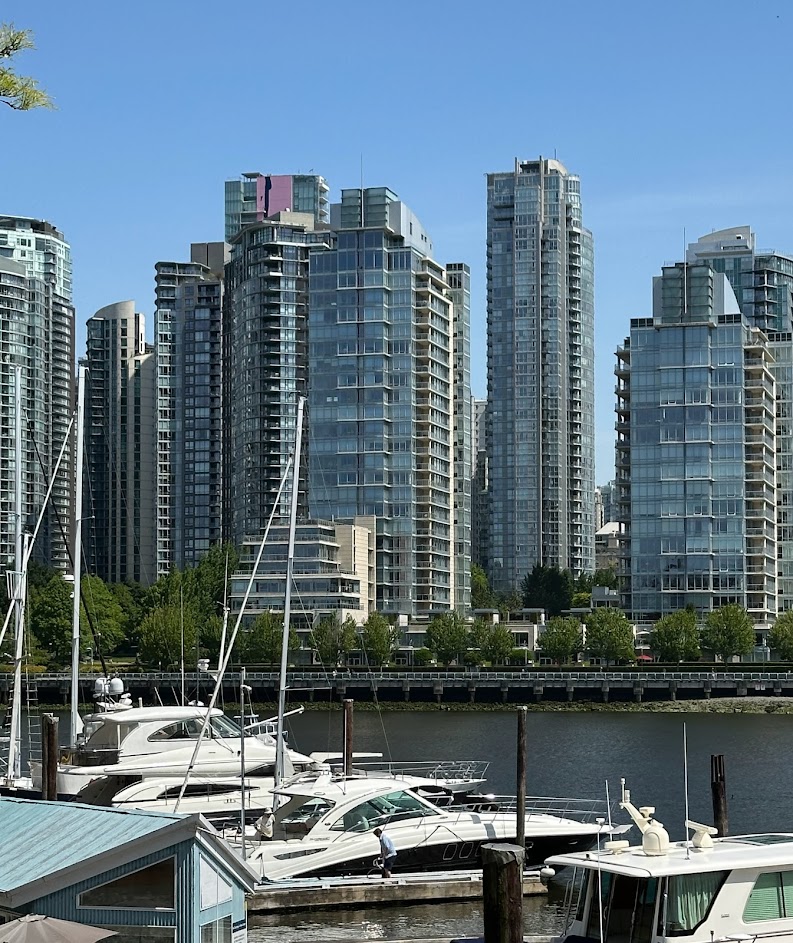
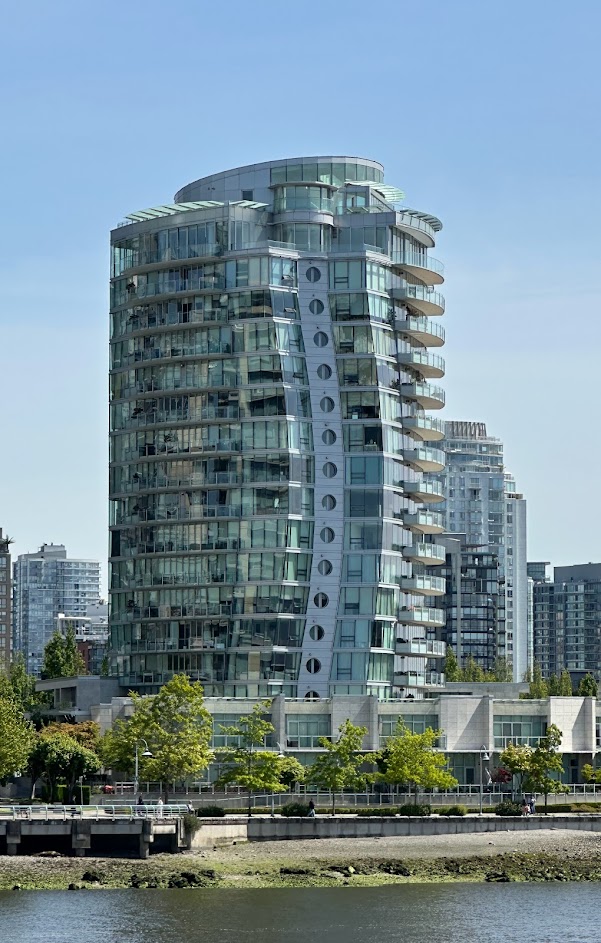
To enjoy our sweets and coffee, we sat in the outdoor plaza outside the Public Market on the waterfront. The skyline of downtown Vancouver stretched before us, resembling a mushroom of high-rise buildings with attractive designs. Each unit appeared to have a balcony, allowing residents to take advantage of the surrounding views. Among them was a distinctive high-rise designed by Arthur Erickson, one of Canada’s most renowned architects. This unique apartment building bulges in the middle, making it an eye-catching sight. Although it may seem unusual, it stands out from the typical apartment towers.
As we walked along the waterfront, we noticed several houseboats tied up at the dock. Interestingly, most of these houseboats are two stories high and seem to be permanently moored to the shore. It makes you wonder what it would be like to live on a houseboat in downtown Vancouver. Would the residents have children? There are no schools or playgrounds on the island, although educational facilities are available on the mainland. Is this lifestyle suited only for adults?
There are two rows of boats tied up—one along the wall and the other tied to the first row of houseboats. I wonder if the first row of houseboats, which is next to the shoreline, is cheaper to dock but lacks a view because the second row of boats is parked in front of them. The density of the boats is so great that they are touching each other! Is there any privacy here? One would assume that good neighborly relations would naturally develop.
As we walked between renovated buildings, we passed restaurants, a community center, and many performing arts theaters. The Emily Carr University of Art and Design is also located there. We walked by the Granville Island Brewery, but it was too early for a beer.
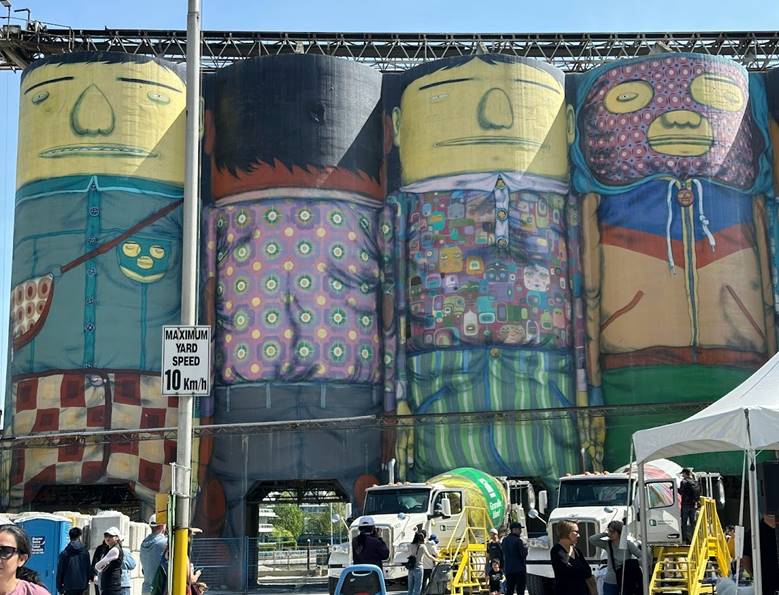
Forties music drew us to a large plaza in front of the Ocean Concrete Company, the longest-established tenant on the Island since 1917. This cement factory features concrete silos decorated with a colorful mural by the Portuguese brothers Pandolfo, titled “Giant.” Despite the huge cement trucks parked in front, the mural made the industrial neighborhood feel more appealing. The music was coming from an outdoor free concert performed by the Firemen’s seventeen-piece band. We stood and listened to my favorite style of music until a few chairs became available in the plaza, allowing us to sit down.
Leaving the music behind, we walked along the waterfront, taking in the views of Vancouver’s skyline and False Creek. The wooden boardwalk felt comfortable under our feet. As we strolled, we passed by an upscale waterfront restaurant that is part of the luxurious Granville Island Hotel, our destination from which we called an Uber to return home.
Although we spent only a few hours on the Island, we could have easily spent the entire day exploring the galleries and studios of local artists, visiting the cement factory that offers tours, and enjoying the brewery.
The mixed land uses, the variety of local shops, the vibrant arts scene, and the bustling crowds reminded me of Jane Jacobs’ ideas about urban environments. Her philosophy is detailed in her bestselling book, “The Death and Life of Great American Cities,” published in 1961. Jacobs advocated for the renovation of old districts by preserving buildings, promoting mixed land uses, and encouraging high-density living with numerous streets to create dynamic urban spaces. She vehemently opposed urban renewal and redevelopment, especially those led by professional planners, favoring instead organic growth guided by local communities. Granville Island serves as a prime example of her principles in action.
 andrasthehun.ca