My Rant Today

January 30, 2025

I’m feeling rather irritated right now. The US administration’s illegal actions are shocking. How can they do all of this? They are firing civil servants protected by legislation and freezing programs Congress approved and funded. Surprisingly, I have seen little outrage or opposition in the news yet.

Why does this matter to me? I live in Canada and am not a U.S. citizen, but I have friends and family there and visit them often. The new president’s recent actions require observation; only time will tell if their impact exceeds mere headlines. The administration might revoke some orders. However, given the recent announcements, it is not unrealistic to expect border restrictions or even the requirement for visas to enter the U.S. from Canada. That would be pretty inconvenient.

Two items about the recent batch of activities surprise me. Disgust me is the right expression, and one is bullying. The handling of the Colombian affair is a prime example. When Colombia refused to allow US military planes to land, the US administration announced tariffs on the country, knowing it could devastate its economy. That was, instead of trying to resolve the conflict gentlemanly and diplomatically. The complaint from the President of Colombia was understandable. The US response wasn’t a measured reply but a brutal attack.

The other item is the incredible ignorance shown by the administration. The case in point is the President’s request to Jordan and Egypt to take in Palestinians. It has been policy by both countries not to allow Palestinians to settle in their countries; Jordan already has millions of them, and Egypt fears terrorists. Furthermore, both countries advocate for a Palestinian state, but what becomes of this goal if Palestinians vacate Gaza? As well, the Palestinian people do not want to leave their land. This is common knowledge. So, why would this administration flog an idea that has no currency?

Political events do not form my discussions with friends and family in Canada and the US. I know such subjects lead to significant disagreements, especially those concerning President Trump. He is a convicted felon and a liar whose only interests are to amass power and money. Think of his cryptocurrency coins, selling running shoes, etc.

He talks a good game, but I do not see how his policies benefit his supporters, except business people expecting a tax cut. And that baffles me. Did he con his supporters, close to half of all Americans? An example is the State of Louisiana, which receives over fifty percent of its budget funded by federal sources. The temporary shutdown of all federal programs announced Tuesday would have devastated the heavily Republican state of Louisiana, which relies on federal funding for over half its budget (fortunately, the order was rescinded today).

Trump’s campaign involved outlining his policies, and he’s currently implementing them. Did people vote for him but not believe him? In my experience, the American people are not stupid. I studied and worked there. Recent events, however, have negatively affected my viewpoint on the American people. Republican legislators are eyeing social programs for cuts to free up money for tax breaks for the rich, actions that would have disastrous impacts on the many people who voted for him.
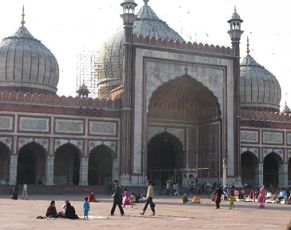
Exploring Delhi: A Day in India’s Bustling Capital

January 19, 2025


We flew to Delhi, where we spent one day—quite an introduction to India! Our hotel was outside of Delhi’s center, accessible by subway. Shyaam, our guide, led us on a subway journey to Old Delhi’s historical sites and bustling market. We followed Shyaam through the crowded streets. The heat made me wipe the sweat from my face. It felt as if we walked a long way, only to discover that the distance covered was only a few blocks.

Rubbernecking to see the small stores and fighting the jostle of people was tiresome. After a while, we were ready for a snack and looked longingly at the street vendors with their steaming foods. Shyaam cautioned us about buying from a street vendor and suggested that we wait for the next round of freshly cooked food to be ready to eat rather than take the already prepared food in bowls on a counter along the street full of flies munching on the food. So we waited ten minutes for the next round of cooking. It was worth the wait—it was delicious; I think we had chunks of lamb with spices I was unfamiliar with.


The atmosphere in that part of town differed from what I have ever experienced. Besides the teeming crowds, with the temperature hovering in the upper thirties Celsius, the smell of spices permeating the air was powerful. In this district, spice store after spice store with hundreds of spices competed for attention with fancy exhibit boxes containing almost every spice imaginable: mustard seeds, coriander, garam masala, and others. A dispute unexpectedly flared up outside a spice stand between a customer and the store owner. Almost immediately, a large crowd gathered, and yelling started. We were made acutely aware of our vulnerability and the potential for sudden violence by the crowd’s sudden outburst and rapid gathering. I told Kathy we should just move on and leave the crowded sidewalk before violence broke out.

Among the sites Shyaam took us was the Jama Masjid, the oldest mosque in India. A wall surrounded the entire mosque complex, with a football-field-sized plaza in front of the mosque, large enough to hold 25,000 people. At the entrance gate, they directed us to take off our shoes and leave them on the steps leading up to the mosque, next to hundreds of others’ shoes on the steps. I was wearing my good walking shoes and was nervous about leaving them on the steps, but we had no choice; I thought of someone just coming out of the mosque and taking my shoes by accident.

Jama Masjid

But taking off our shoes was only part of what they required. They also gave us a gown to wear over our street clothes. Inside the complex, children played and ran around in the plaza, and adults walked around in gowns. The courtyard seemed like a vast, paved urban park without trees and greenery. Aside from the gowns, it could have been anywhere.

The Jama Masjid is like other mosques we have seen; it is a large space with the women’s quarter separated upstairs. The mosque was completed in the sixteenth century in the old city. The huge mosque in Casablanca, the Hassan II, is like this one, except it has no walls around the large plaza outside and was built recently (finished in 1993). I did not get the religious vibes here that I felt visiting the Cathedral in Santiago de Compostela, perhaps because I am a Catholic and not a Muslim. We left the mosque, and I found my shoes, which I had left outside.


Following our visit to Jama Masjid, Shyaam guided us to Sheeshganj Gurudwara, one of Delhi’s nine historic Sikh temples (the name means “gateway to the guru” in Punjabi). Unlike the mosque, worshippers, women, and men gathered together on the floor in the principal room. As part of the temple’s mission, a women’s auxiliary made naan bread in a small side room to feed people experiencing poverty. They were working quietly, without speaking, a welcome respite from the hustle and bustle outside. They invited Kathy to sit on the floor and join them in making naan. She did it for a while to learn how to make naan, which was more challenging than it looked.


Leaving the Gurudwara, we took Delhi’s spotless subway to Connaught Place, the center of New Delhi. Shyaam escorted us onto the subway train, gave us directions on how to return to our hotel using the subway, and left us to explore. Connaught Place differed from Old Delhi. It was a large circular park with benches on a grassy field. Seven major roads radiated from the perimeter into the urban fabric of New Delhi. Its street-level stores and mid-rise office buildings around the circle reminded me of North American cities. Unlike in Old Delhi, the streets were uncrowded, and the stores were spacious.


Feeling confident in our navigational abilities, we took the subway back to our hotel. I found the subway extremely clean, although crowded. Upon entering a station, all passengers underwent a security check similar to those in airports: a metal detector check and a baggage check. They allowed no food or drink. This rule and its enforcement ensured cleanliness. It was impressive. We got off at the right subway stop; however, with no idea of the geography and, I guess, not having paid enough attention to our surroundings when Shyaam had accompanied us downtown, we had no idea whether to go left or right when we got off and stood there like the lost tourists we were. Luckily, many Delhi residents speak English, and a very kind man helped us find our hotel. This gentleman’s helpfulness, in retrospect, did not surprise us, as we have found in our travels that Indians are friendly people.

Unboxing My New iRobot: A Weekend Adventure

January 12 2024

The new iRobot arrived from Amazon, but I delayed opening the box. Things were about to get difficult.

That old iRobot developed some bad habits. Like older people, it got cranky; sometimes it worked, sometimes it did not. The situation was far more frustrating than the word suggests when the machine spun around in a circle and went home like a dog refusing a walk. So, it was time to get a new one.

There I was, examining the sizable box holding my new iRobot. When I receive a new product, I usually empty the box to see all the items sent and then look for the one-page instructions.

Assuming that the new one needed powering up, I plugged it in. I then consulted the instructions, but the print was too small to decipher. With a magnifying glass, I discovered that of the dozens of pages, only two were in English. The other pages had identical text in dozens of languages, each two pages long.

Besides the instruction manual, I found two cards with QR codes. I have an iPhone, so I had no trouble taking a picture of the codes and reading the instructions. But what if I had no iPhone?

No other instructions were provided beyond the miniature English text and QR codes. From the two pages of text, I learned to charge the machine until the swirling white circle around the start button stopped. The other and more critical instruction was to “pair” my iPhone with the iRobot. Once I paired my phone with the cleaning genius, instructions arrived.

The first command received was to give my machine a name. We discussed the name. We didn’t intend to imply cleaning is women’s work, but finding a gender-neutral name souncing good to both of us proved difficult. The current recognition of multiple sexes makes using “(he/she)” after names too lengthy. Our old iRobot, Matilda, has a namesake: our new iRobot.

Soon enough, my iPhone indicated Matilda was ready to clean. I punched the starter button, and Matilda came off her base. Then she took off towards the bedroom, changed her mind, and returned to crank around her base. After that, she seemed to meander aimlessly in different rooms until it ran out of juice, returned, and mounted her base for a refill.

I was disappointed by the short amount of time Matilda spent cleaning. At this rate, she will need three or four charges to clean the main floor. The old and faithful Matilda did the entire floor with only two charges.

By now, not knowing what to do next and in a frustrated mood, it was time to call customer service. Connecting with a very courteous gentleman with a foreign accent did not take long. A nagging question about his location tugged at my mind, though I felt no desire for interaction in my current mood. He told me to charge Matilda three hours before starting. I had charged it for less than an hour because my iPhone informed me Matilda was ready to dance. The swirling was slow, and my iPhone said Matilda was ready.

Another key information I learned from the representative was to press the “map” button first so Matilda could survey our house, measure the rooms, and map them in her memory. The first time around, she will not clean, he said. I asked where the map button was. I saw the word map next to the Google symbol for maps, but when I touched the symbol, Matilda jumped off the base and started cleaning. No, the customer service gentleman said. Just touch the words “map,” not the symbol. And so, we made friends with Matilda, and once charged for the third time, she cranked around the entire main floor, mapping our house without cleaning.

She mapped our house into her memory and even called the rooms by their names. For example, there was a living room, bedrooms numbers one and two, and so forth. She correctly identified our Christmas tree, calling it ” the Holiday Tree,” the accepted word for it by today’s standards. How the hell could she recognize it? The star-shaped footing for the tree may have given her the information around which she had to circumnavigate. Very smart. And if I did not find the floor plan realistic, I could correct it on my iPhone.

Now that Matilda had our floor plan in her plastic body, I could enter a ‘new project,’ check the rooms to be cleaned, and then punch the start button.

Opening the box, figuring out the instructions, calling for customer help, and waiting for Matilda to charge and recharge took most of the weekend. Now, with the floor plan in Matilda’s mind, I can still change. I understand how to use the new iRoboy and could retire old Matilda to the basement should she return to life.  

Phew! I relaxed and poured myself a glass of wine, celebrating success. Then the realization hit me: did we not get this model because it is not only self-cleaning but also “mops.” (Self-cleaning means we do not have to empty the dustbin. She does it herself by having a massive blow into the base when she finishes the assigned project and returns to the base). Yes, she does mop with water! Aha, that is why there was another gadget for mopping in the box, into which we put some water. Boy, I’ll need another weekend to figure out how to mop with Matilda! I’ll sit on it for a week before initiating another adventure with Matilda.

Exploring Panjim and Old Goa’s World Heritage Sites

January 2, 2025


Arriving in Panjim, the capital of Goa, we made our way to our small hotel in the downtown area. Our contact there arranged a driver to go sightseeing.


The next day, the driver took us to Old Goa, where UNESCO declared a large area as a World Heritage Site in 1986. Sultanates ruled old Goa, founded in the fifteenth century on the banks of the Mandavi River until the Portuguese captured it in 1510. The Portuguese ran their colony from Old Goa until they moved the viceroy’s residence to Panjim in 1759. During their stay, the Portuguese had built several Catholic churches in and around Old Goa. With the viceroy’s departure, Old Goa’s religious significance diminished.

We walked over to the UNESCO World Heritage Site, which contains seven historical churches, one in ruins and the others in different stages of renovation. The builders constructed the churches in the Baroque architectural style. Although we found this site significant, it is less interesting architecturally. We have seen several more interesting World Heritage Sites in India (thirty-eight such sites in India).


Half a day spent wandering the buildings was adequate for us. It was a hot day with temperatures in the thirties (over 100 degrees Fahrenheit). We walked with our water bottles in the sun on the heritage site’s grassy field.

I recommend seeing the Basilica of Born Jesus on this World Heritage Site. It is famous for containing the remains of St. Francis Xavier, founder of the Jesuit Order, and associated artifacts, including his casket.


The other edifice we enjoyed was the Chapel of St. Catherine, a small building needing renovations but uncrowded and surrounded by vegetation providing welcome shade. Alfonso de Albuquerque built this chapel when he took possession of Goa in 1510 on Saint Catherine’s Day (November 25th). We took a hydration break at a small kiosk and called our driver for the return trip.


While heading back to Panjim, approximately ten kilometers down the road, the driver paused to grab a jacket upon getting a phone call. He said the police were monitoring taxi drivers further up the road, and the law required drivers to wear a formal dress or pay a hefty fine. I thought this regulation concerned creating a professional image for tourists.

According to the driver, in Goa, people view being a police officer as rewarding due to their ability to stop and search individuals for any reason. And people will negotiate and pay cash to avoid being fined. Applicants to the police force will pay bribes to get an interview. Families join to raise money for a family member who, if successful in becoming a police officer, supports the entire family

We walked around Panjim, which has a population of about 100,000. It has a European feel, with low-rise buildings and curvy streets. We enjoyed the many small stores lining the streets and stopped by an optometrist whose prices were low compared to prices in Canada. They offered us a plan whereby we gave them our prescriptions, and they would fill them at any time at a low cost for an annual fee. We considered it but decided against it, thinking of the time it would take to get glasses mailed to us. Shoppers and passersby were helpful with directions to the Bishop’s Palace; however, the impressive, two-story building was closed on our arrival.

The next day, we visited a beach, a major tourist attraction in Goa. Thinking an hour would get the smell and atmosphere of the beach; we told the driver to wait. Upon stepping onto the sandy beach, hawkers surrounded us, trying to rent umbrellas, sell refreshments, and offer massages. I struggled to shake them off without resorting to discourtesy. It was not a pleasant experience. Their presence stemmed from business opportunities.

Understanding the language, I listened to the Russian tourists on the beach availing themselves of the full range of services. Also noticeable were the women in long sarees, which they wore into the water with their children. An early bedtime preceded our 4:30 AM flight. My anxiety grew with each passing moment as the cab failed to arrive. I called the driver several times and was told he was on the way. He explained his tardiness one hour late: the airport was only 30 minutes away, and a few flights meant no rush. He was right, and we boarded Qatar Airways to Doha and Washington, DC, connecting with a United Airways flight to Ottawa. We arrived on the same day as the day we left, even though we had twenty hours of flying time with five hours’ waiting time in between flights.