Sistine Chapel Exhibit Review: A Mixed Experience

Janury 27, 2023

Three Views of the Sistine Chapel

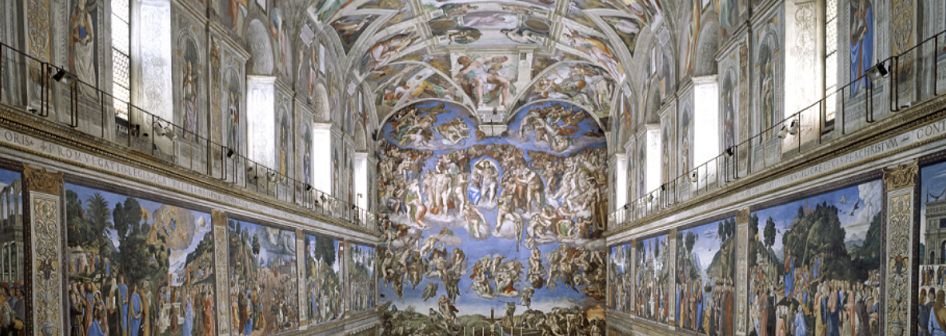
I was underwhelmed viewing the Sistine Chapel touring exhibit, produced by Entertainment Events Inc. (EEI) of Hollywood (showing only the ceiling frescoes painted by Michelangelo). The first showing of this exhibition was in Montreal in 2015, after which it toured the world and arrived in Ottawa in December 2022.

 In Ottawa, EEI presented the exhibition at the EY Convention Center, in a large, industrial type of space, like an airplane hangar. It just did not have the aura for showing biblical scenes painted by Michelangelo on the ceiling of the Chapel. What frosted me was the advertising for yoga classes at high prices, taught in front of the paintings. I found the combination of appreciating renaissance paintings with concurrent yoga exercises jarring. But the receptionist told us the yoga classes were fully subscribed; I could not see myself putting my body in yoga poses with great effort and appreciating the artwork simultaneously.

There were no brochures or handouts to describe and explain the paintings, this was Covid times. Instead, you had to bring your cell phone, to which you could download, via a QR code, the explanatory comments. Once we figured out the technical challenges, we found the commentary useful.

Before looking at the pictures, we listened to an introduction to how Michelangelo accepted a commission from Pope Julius II and built a scaffold to paint the ceiling at a height of sixty feet in the Chapel. Michelangelo used vivid and colorful paints on wet gypsum and completed the work between 1508 and 1514. EEI used high-definition photographs to reproduce the paintings in full size.

The full-size biblical scenes were twenty feet above the floor at the EY center, enabling viewers to see the pictures, including brush strokes, in granular detail; that was a major benefit of this show according to EES, compared to seeing the same pictures sixty feet above the ground in the Sistine Chapel.

This exhibition was attractive to art buffs and religious historians, especially those familiar with the Bible; but to me, it does not compete with seeing the real Sistine Chapel in the Vatican, which we visited in 2015. The comparison is like watching a football game on TV versus attending in person. It is hard to describe the excitement of walking through the Sistine Chapel with hundreds of people, all sighing with wonder at the pictures, even though they are sixty feet above you, and seeing not only the ceiling but also the walls, painted by other renaissance artists. But at the touring exhibition, one could take time to study the Michelangelo painted frescoes at a close distance without a crowd.

Although the excitement was tangible within the Sistine Chapel, there were detractions: some people took photos despite being warned not to do so. And the guards kept hushing people to be quiet. As well, when we went, the crowd filled the Chapel wall to wall, and the guards nudged us to move on to let the other visitors come in.

I found the best way to see the Sistine Chapel (if you have internet access and a computer), is to log in to https://www.museivaticani.va/content/museivaticani/en/collezioni/musei/cappella-sistina/tour-virtuale.html This site provides a virtual tour. You can look at all sides, plus the floor and the ceiling of the Chapel. If you want to see more details, you can enlarge the pictures. You may miss the excitement of being in the Chapel, but you do not have to travel to Italy, line up with hundreds of tourists at the entrance and have a limited amount of time to look at the paintings.

Walking through the Sistine Chapel in the Vatican, and looking at stories told by the colorful frescoes, made an everlasting impression on me. I found this quote that reflects my sentiments: “Without having seen the Sistine Chapel, one can form no appreciable idea of what one man is capable of achieving” (Johann Goethe, August 23, 1787).

 Having seen the original work, the touring exhibition was disappointing for me but would be attractive to people where the touring exhibition goes. If your city is not on the touring exhibition schedule and you do not have the time and money to visit the Vatican, the website above provides an excellent way to see the inside of the Sistine Chapel.


The Challenge of Tipping at the Taj Mahal and Other UNESCO World Heritage Sites

January 16, 2023

We caught an early Indian Railways train in Delhi to get to the Taj Mahal in Agra. There was a substantial breakfast served by a dapper, uniformed porter on the two-hour train ride. We joined a long line of people waiting for the opening when we arrived at the Taj at 7:00 am. Inside, several official guides competed for our attention.

One guide, a small man with a starched white shirt and tie and formal manner, offered to show me where to take the best photo shots, including where the shots in the James Bond movie Octopussy were taken. Believing he was a government employee on the Taj grounds, I thought his services were free.

He took me on an extensive tour that lasted more than half an hour. He knew the story of the Taj. And he showed me a glorious spot to take a picture of the Taj, from an arcade looking at the front of the Taj, framed by an arch above. It is a novel snapshot that shows the Taj with the minarets at the four corners. It was early in the morning, and the white marble building showed unforgettable translucency in the rising sun.

I thought that even though he was a government employee, I should at least offer him a tip for his tour and offered as much as the entrance fee. He asked me what it was for. I said I wanted to show my appreciation for his time with a tip.

He stared at me in astonishment, then laughed and explained that I did not realize what an expert story he shared with me and that at least ten times what I offered would be a minimum to pay for his expertise. His gall and arrogance astonished me. I was going to negotiate but got my back up at hearing what I thought was an outrageous demand. I told him he had never said that he expected remuneration and that if I had been aware that he would expect so much money, I would have refused his offer for the tour. And I started walking away.

He called after me and negotiated to double my original offer. I chalked up this encounter as an experience in traveling at world-famous tourist sites.

This incident reminded me of an episode we had in Jaresh, Egypt, where we paid for a guided tour. The guide was excellent, and I offered what I thought was a generous tip, which he pooh-poohed and told me to give it to the paperboy and explained in a loud voice that he was worth ten times as much. I finally just started walking away from him, leaving an amount equal to the entrance fee that the guide then threw to the boy selling trinkets at the gate.

From these two experiences, I gathered that, as an initial gambit, the guides ask ten times what you offer, but are happy to accept less than half the suggested tip. I found tipping an unpleasant task with educated and experienced guides.

Traveling in Morocco (Fez) and Egypt (Karnak), the distinguished-looking guides, those with a suit and a tie, had a much more sophisticated approach to earning money. These guides took us on tours that ended up in a gift store, where they expected us to buy artifacts in the store made by local artisans. I noticed that when we left; the guides had a few words with the owners of the stores, and my strong suspicion was that the guides received a kickback, a percentage of the amount we spent in the store.

Some of these guides are professional historians and provide excellent guided tours. But they are also aggressive in securing huge tips by shaming the Westerners, who are often seduced by suave guides with a suit and a tie on, university professors moonlighting as tour leaders.

I found group tours are better, in that they include tips in the price, although the guides always expect additional money.

Regardless of such annoyances, the Taj is a great place to visit. It is a unique building that has an eerie, light feeling in the sun and is surrounded by a well-maintained garden. When leaving, the guards at the gate told us that there are always lots of tourists there.

Towards Solving the Housing Affordability Gap in Ottawa: The Vacant Unit Tax

January 15, 2023

Can a family afford to buy a house in Ottawa? The average family income in Ottawa is $80,000. If they had the money for a 20% down payment for an average Ottawa home costing $620,000, the monthly mortgage cost would be over $2,000. In addition, they would have to pay for utilities, food, and other living costs. The other option, next to buying, would be to rent a house or an apartment, and the family with two children would pay a $2,500 monthly rental cost (a house or a 3-bedroom apartment).

I think there is an affordability gap in Ottawa, or, there is a shortage of housing. Same thing. Economics teaches us that if we increase the supply of a product, it may decrease its price. Home builders built ten thousand dwellings in Ottawa in 2022, a record, but not enough to satisfy demand. Are there other options to increase the supply of housing?

The City of Ottawa thought of another way to increase the supply of housing and introduced a “vacant unit tax” (VUT) on January 1, 2023. There are 20,000 vacant units in Ottawa, five percent of the housing stock. Carrying the higher cost of an investment property may motivate owners and investors to rent or sell their vacant units, increasing the housing supply, and reducing its cost.

The tax is one percent of the assessed value of the property if it is vacant for over six months of the year. Although some people with deep pockets may pay the tax, others would sell or rent it out, perhaps to family members to avoid paying the tax.

How will the City of Ottawa identify vacant units? Following examples in Toronto and Vancouver, with similar taxes for vacant investment properties, Ottawa issued a form letter to all property owners asking them to declare whether their property is their prime residence, rented or vacant. We must submit the declaration by the middle of March. Failing that, the tax is added to the property tax the following year.

What happens if owners claim they rent the property, but it is vacant? How will Ottawa follow up and audit, and enforce the VUT? Would the City check water, gas, and electrical consumption for the dwellings? The City has not disclosed how they intend to audit and enforce its new tax; it could be an arduous process.

The City projects to raise seven million dollars a year from the VUT, which translates into over 1,100 dwellings subject to the new tax ($7 million is one percent of the assessed value of the vacant homes averaging $620,000).

It appears the City is inconveniencing 100 percent of property owners by requiring a declaration to increase the supply of housing by 0.3 percent (1100 units added to the existing 380,000 occupied units). Is it worth inconveniencing the people of Ottawa for such a small gain? Is this just a tax grab, impacting middle-class people?

What I find more objectionable is the creeping regulations limiting our freedom; why could I not have two homes and have one empty without being taxed for it? For example, I could use one as my primary residence and the other as an office or a studio or the guesthouse for visiting family. Or I could live downtown, for the winter, to enjoy the cultural facilities there and move to an ex-urban area for the summer, where I could have a large lot with my vegetable garden. Would this tax encourage families to put one house in the husband’s name and the other in the wife’s name? And both could claim their houses as primary residences while living in one? What is wrong with a two-primary-home existence?

And creeping regulations could go further: following up on the logic of the VUT, Ottawa may prescribe additional living standards. For example, you may be eligible for five hundred square feet of living space per person or one bedroom per person. And come up with the LUT (large-home unit tax). If they can regulate that my dwelling must be occupied, what is stopping them from deciding how much space I am entitled to?

Reflecting on the increasing regulatory power of the City, I thought of the large house we and my neighbors occupy. Yes, my street has large homes with four or more bedrooms and multiple bathrooms occupied by two people; the children are gone but the owners are comfortable in their long-term homes, with no intention of moving or downsizing.

I was in my large basement office filling out the VUT form, thinking that the VUT may not be the efficient answer to the housing affordability gap. Mortgage rates, lack of skilled labor to build houses, and low wages may be more crucial factors to tackle before trying to convert a few vacant homes into occupied ones. Just my opinion.

Disappointing Impressions on my Return to Ottawa from Charlotte, North Carolina

January 5, 2023

Driving along Merivale Road, in Ottawa, my neighborhood looked run down and dirty at the end of December. Yes, the melted snow was dirty gray bordering Merivale. And the road was full of potholes. As well, it was overcast and gray and the designless and helter-skelter development that has sprung up over the years along

Merivale showed its age and need for updates.

I felt depressed and found the contrast with sunny Charlotte with its clean, well-maintained streets and shiny new shopping centers dispiriting. I left Charlotte the day before.

Ottawa’s infrastructure has deteriorated, and maintenance declined over the years. For example, the snowplows cleaned a wide swath of roadbed years ago compared to the narrow lane left today after the snowplows drive by.

Has the quality of my neighborhood gone down? You be the judge. I’ll just describe what has been happening in my neighborhood, along with my biases.

First off, we have “cash marts” stores just around us, stores I consider cater to people who are hard up and must cash cheques to survive on a day-to-day basis. Sure, there are people like that, but I thought my neighborhood was a more stable, middle-income area with expensive homes.

A block from us, a cannabis store opened and there are a few more of them, less than a mile away. Again, there must be a market for such outlets, but I did not think my neighbors were into drugs. Maybe I am getting old and out of phase with today’s reality.

I do not cotton to cash marts and cannabis outlets in my neighborhood, especially when we also have bottom-feeder consumer outlets like “dollaramas” and used clothing establishments like “value village”. Should I go further?

There is nothing wrong with cash marts, cannabis outlets, and hand-me-down clothing stores. There is a market for those. But coming back from well-maintained Charlotte where I did not see any of these (cannabis stores are not allowed in North Carolina), driving along Merivale Road, with the dirty snow along the road and navigating around potholes on a rainy, gray day, was a downer for me.

But wait, are there any bright spots? I drove by a plethora of ethnic food establishments, which I like, including Chinese, Japanese, Korean, Indian, Mexican, and Italian, besides traditional English fare. The neighborhood also boasts two sports pubs and takeout places for pizza and chicken. And we have several food store chains near us, three in walking distance (Walmart, Loblaws, and Food Basics). These are great conveniences, along with a Starbucks and a couple of fast food/hamburger places (A&W and Harveys). None of these outlets are fancy; they are run-of-the commercial chains. Maybe I should not say that these are bright spots, but I cannot complain about the lack of eateries or grocery stores in my neighborhood.

But beyond the food scene and the usual gas stations, banks, and a couple of gyms, there are no upscale retail stores or cultural/entertainment facilities at all. The area just does not, or could not, attract fashion, electronics, furniture, or other upscale stores over the years. I am not sure why.

Is my neighborhood on the downslide? Maybe not. Maybe it is in transition; the low-slung, decaying buildings are probably rented at reasonable rates, therefore many family-run ethnic outlets can thrive.

But we also have a sea of parking lots and with the growth of the city, further development via densification will happen. We’ll be looking at mixed highrise buildings, with commercial establishments on the lower levels topped by residential units above.

Last fall, I joined zoom meetings with developers and Ottawa city planning staff, reviewing development proposals. In this process called “public engagement”, the City attempted to draw out public opinion on private proposals. In the proposals we reviewed, there were thousands of residential units in highrise buildings, within walking distance from my place, all containing commercial uses at the lower levels.

I drove home and after thinking about the planned developments I saw in Charlotte; I decided I much prefer those to the haphazard, aging, and messy character of my neighborhood. Unfortunately, my area will change, and I am not sure it will be for the better. I am afraid unaffordable rents in the future may squeeze out my favorite small mom-and-pop food operations, unique in my neighborhood. On that gray day after my return from sunny Charlotte, I felt in the dumps driving along Merivale Road.