A Milestone Event: High School Graduation in Baton Rouge, LA

May 21, 2022

It was a hoot. Literally. People were shouting, hollering, and hooting every time the principal shook hands with each graduating student, handing out their diplomas. The noise was at airplane levels, but positive, with commentary encouraging the graduating class to go forward in life. 

The event was my grandson’s graduation from Baton Rouge Magnet High School (BRMHS), which I attended, along with thousands of parents, siblings, and friends, celebrating the graduating students. It took place at the Pete Maravich Assembly Hall, the home of the Louisiana State University basketball team. More than half of the Hall was filled, which has a capacity of 12,000 seats.  

Security was tight. We had to have tickets, and could not carry an object larger than a cell phone or camera with us. Many people were scurrying back to their cars with purses and iPods, and larger objects that were not allowed. 

The atmosphere inside was boisterous, from toddlers to grandpas talking excitedly, enjoying the moment of graduating students embarking on the next stage of their lives. And leaving the family home.  

We could all see the action on the stage on a huge screen hanging from the ceiling like in hockey arenas. There were 369 chairs in the middle of the floor for the graduating class.  

The commencement exercise started with the school orchestra playing “Pomp and Circumstance” while the graduating class walked in two at a time, followed by the next two fifty feet behind. The orchestra played, repeating the music, until all the students took their seats while the crowd stirred in anticipation. 

Invocation and the Pledge of Allegiance followed, and the national anthem sung by the school choir. After the senior class president welcomed the people, the principal of the school gave an overview of the year; this was her twenty-second graduating class.  

Both the salutatorian and valedictorian gave rousing speeches, making fun of some of their experiences as well as the teachers, in good fun, to the wild applause and laughter of their compatriots sitting and clapping in their chairs.  

Then all the graduating students were called up onto the stage, alphabetically, in a stentorian voice. And this is when the noise level intensified. Families and friends of each student broke into a frenzy of hundred-decibel hoots, waving their arms to be recognized by their son/daughter on the stage, who shook hands with the principal handing out their diplomas. This went on for a couple of hours. When all 369 students received their diplomas, they threw their hats into the air in celebration. 

We left the Hall to wait for Alec, our grandson, and stood by “Mike the Tiger’s” cage. Mike the Tiger, a mixed Siberian-Bengal tiger, is the live mascot of the LSU Tigers football team. Mike lives in a multi-million-dollar habitat. The cage with Mike inside used to be pulled around the football field before games with cheerleaders dancing on top, and for Mike’s every growl, the football team was expected to make a touchdown. We waited for Alec by the Italianate campanile, a part of Mike’s habitat (the architecture reflects LSU’s buildings).  

 People were pouring out of the Hall, waiting for their newly minted graduates who were socializing with each other for the last time as students of BRMHS. It took half an hour to loosen Alec away from his friends. 

BRMHS is a magnet school, a category of public schools that emphasizes specific educational themes. The school Alec attended emphasizes academic performance, and interestingly, his class had a great diversity of students to grow up with (31% black, 22% Asian, and 7% Hispanic. And Alec confided in me that 80% of the students were girls, lucky for him). 

I found the entire experience uplifting in providing the young graduates a solid milestone in their lives. Our three children went through high school in Canada where these events were much more sedate and low-key, performed in the gym of the schools. And, of course, I never finished high school. I walked out of Hungary when I was in grade ten and, after arriving in Canada as a refugee, the University of British Columbia in Vancouver admitted me with no high school diploma.  
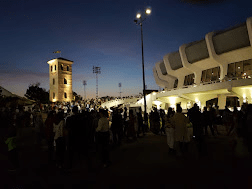
People pouring out of the Pete Maravich Assembly Hall after graduation, in Baton Rouge, LA, with Campanile on the left, a part of Mike the Tiger’s habitat. 

The Friendly Americans

May 19, 2022  

We were driving along highway 37 in upstate New York when there was a beep and the dashboard in the car flashed a message that our tire pressure was low. A few weeks ago, I had the regular tires installed replacing the winter tires, and thought the mechanics checked tire pressure automatically. Our destination was a thousand miles south, and we had to fix the tires.  

We stopped at the next gas station and looked for an air pump. Not seeing one, I asked a couple of fellows working on a truck if they knew whether the station had an air pump. They pointed to the back of the station but warned that the pump had no pressure gauge built into it and asked whether I had a pressure gauge. I said I did not have one. But I backed up to the pump and thought of putting some air into all the tires anyway. To get the warning light off. 

As I backed my car to the air pump, one fellow I talked with came over and handed me a new pressure gauge, still in a paper package. I opened the package, and, using the gauge, discovered that the right rear tire had less pressure than the other three tires, so I put some air into it.  

When I finished pumping the tire, I went to return the gauge, only to find the two fellows had left. At the gas station, I inquired whether the gauge came from there and if so, I wanted to pay for it. But the clerk said the fellow purchased the gauge costing over five dollars. So, a total stranger bought the gauge for me! What a friendly and helpful gesture that was.  

Why would someone purchase a tire pressure gauge for a total stranger? If he had one, he would have let me use it. But buying one? Perhaps I looked totally inept, and he tried to help me by buying it. But maybe he was just being friendly and trying to help a stranger who needed help? I was totally taken by this friendly gesture. And that friendliness extended to the clerk at the station who chatted with us and went out of her way to check the price of the gauge.  

This was not the first time someone stopped on the highway to help us. We were driving north on I40 a hundred miles south of Durham, North Carolina when I blew a tire and stopped on an off-ramp. Before I finished calling the AAA, a friendly person stopped at our side and in less than ten minutes, changed the tire expertly, loosening the lugs; cranking up the car on the side and putting on the spare.  

Not only on the highways but elsewhere too, helpful experiences await you in the US. At the local grocery chain store in Baton Rouge, Louisiana, comparable to our Loblaws chain in Ontario, store people asked me how they could help find items without prompting. It is often difficult to find a store clerk at Loblaws in Ottawa and I have never been approached by a clerk offering help.  

I found the same walking on the streets of Baton Rouge this morning; people said hello and how are you, meeting you. Back home, people are more reserved and often pass you without even acknowledgment.  

I think that friendliness is baked into the DNA of Americans. It may be a historical, cultural trait, borne out of hardships in occupying the country and building communities. Whatever is the root of this characteristic, it triggers a warm feeling inside of you.  

A New Divide: People Who Work From Home vs. Others. Wonking Out

May, 10, 2022

The pandemic has accelerated the trend in “teleworking”, or what is called today “work from home”. Governments and companies encouraged workers who could work from home to do so to reduce potential infections in the office. But who are these workers and what impacts has this movement had on our daily life?

According to Statistics Canada, over thirty percent of workers worked from home, between April 2020 and June 2021. In 2016, only 4 percent of people did so. A massive change in the work environment, mostly triggered by Covid, I think.

The composition of this home-based workforce is interesting. According to Statistics Canada, seventy percent of people who worked from home were in the “professional, scientific and technical services” industry category.

By income, eight percent of people in the bottom ten percent and over sixty percent of people in the top ten percent of wage earners worked from home.

So better educated and higher-income people seem to have been given a greater opportunity to work from home than others (education and income are usually positively related).

But, there are other consequences resulting from this trend. A recent article by a city planner in Vancouver envisioned that the work-from-home movement could result in larger homes because of the need for a home office. And larger homes need vacant terrain to be subdivided, gobbling up choice agricultural lands around major cities in Canada. The article also envisioned a home with more outdoor space than the norm today, considering people will avoid public spaces and parks for fear of infection.

The article surprised me since current city plans, including Ottawa’s, strongly encourage “densification”, to save on infrastructure and minimize carbon emissions by reducing the daily commute. Perhaps the need to build larger homes for work at home will decrease in time, paralleling the elimination of Covid, if that is possible. Not a likely event in the short term.

I provide all of this context to introduce the nub of a potential issue: people love working from home and the trend toward it may create a new divide. The lucky ones may continue the work-from-home routine while others may never get to enjoy it. Now I have not done a professional survey but have anecdotal evidence from talking with many people who love to work at home and never want to go back to the office.

People I talked with gave me many reasons why working from home is advantageous: you can choose your hours of work; you save time by not having to dress up to go to work; you save money by not buying coffee or lunch and commuting (save on gas, parking or transit costs); and you can take care of daily activities like shopping, taking children to school; or go on a bike ride or run when times are nice.

But, there may be downsides as well. You may miss the watercooler talks catching up on what is going on in the office; miss meetings in person where you may find out more about projects through the body language of others (zoom meetings provide less communication than in-person meetings). You may miss opportunities to show your skills and knowledge to your boss in ad hoc situations that could lead to promotions. Recruits may find it difficult to learn the culture of the organization being away from the office. And some people may find it intrusive that some bosses may call you on a 24/7 basis.

Another unanticipated consequence of working from home may be that office buildings stay empty, taking away the livelihood of many businesses serving office workers. But, of course, companies and governments save money on reduced office space demand.

I remember people blamed the recent convoy in Ottawa for destroying the restaurant industry downtown. But have you considered that the government in Ottawa, ordering employees to work from home for the last two years, may have been a key factor that killed the restaurants downtown?

It may take a few years before we see the light on whether the work-from-home trend will continue. But, to date, this movement has created a divide between those who can avail themselves of this attractive way of working versus others who just cannot do it. And it has created incentives toward low-density urban development conflicting with current city planning objectives to densify to reduce greenhouse gas emissions and save good agricultural lands. Just my opinion.

The Curse of Oak Leaves

May 7, 2022

The Curse of Oak Leaves

It is a beautiful May afternoon. The wind is blowing the oak leaves in my backyard and I am sipping coffee and thinking about how much more raking I need to collect the leaves. The piles of oak leaves cover up my plants. Oak trees lose their leaves slowly through the Fall and Winter. I try to get the leaves collected before the snow covers the plants in the Fall. But, of course, cannot collect the oak leaves which fall over the Winter until snowmelt in the Spring.

Oak leaves come from the neighbor; we do not have any oak trees. We have other trees, the leaves of which had already fallen and been collected before snowfall.

Mind you, the leaves are large and beautiful in attractive hues but feel like leather. And that is why they do not crumple, even in time. They survive as whole leaves and cover the ground, killing the plants and vegetation under. So collecting them is a must if you want to keep your garden.

Now it is May again and lo-and-behold, there are still oak leaves in my yard.

When the neighbor moved in decades ago, they planted some sample trees, many oaks, along the perimeter of their yard. It sounded like a good idea. But trees grow and in decades the trees became mammoth.

For example, the ironwood in the corner next to us is over eighty feet tall. The lower branches were scraping and making a hole in my roof, so I had to hire people to take some branches off, which cost hundreds of dollars.

Before the contractor could prune the ironwood, he had to have the approval of the neighbor. So we marched over to the owner of the house next door and I talked with the woman whom we had known for a long time but never socialized with. Her husband died of cancer a couple of decades ago and she has not maintained her yard, nor pruned the trees. But she agreed to have her tree pruned, seeing the professional-looking t-shirt with a company logo, worn by the tree cutter. At any rate, I paid for the branch removal.

Another year, another cleanup of the oak leaves. Another few dozen bags later, I was getting mad: why do I have to clean up after the neighbor? The wind blows HER leaves into my yard. She should clean up. But she does not even clean up her yard except for a day in the Fall and a day in the Spring, hiring a contractor for the cleanup. Is there some bylaw that would require people to clean up their yard? And could such a bylaw be enforced? Or could there be a bylaw prohibiting the planting of oak trees on regular-sized, quarter-acre city lots?

Now I thought of talking with my neighbor when in a good mood and not upset with raking her leaves and perhaps trying to convince her to get her cleanup earlier and more thoroughly in the Fall and the Spring to minimize her oak leaves arriving in my yard. But I decided that would be useless; I chatted once with her before replacing an aging and ugly cedar hedge between us comprising tall poles denuded of green parts and even offered to pay for it, but she refused.

Another idea I thought of was to just dump the leaves back in her yard; they are her leaves. I thought about it and declined to act. She lives by herself and probably needs help. Who am I to give her more grief?

So I keep raking, bagging, and hoping that gypsy moths will enjoy the oak leaves this Spring and take care of my continuing frustration this year.

Free Bus Passes for Refugees in Ottawa

May 4, 2022

Ukrainian refugees arriving in Ottawa provided moving stories in the local newspaper, and discussions with friends centered on the ongoing war in Ukraine.

These discussions moved on from the war and focussed on how to help the refugees arriving in Ottawa. It was encouraging to learn the City councillor from Kanata suggested that free transit passes be provided to the refugees for six months upon arrival. Another Councillor expanded the motion to include all refugees, to be fair. The City Council passed the motion.

A friend of mine suggested that with the free passes, the refugees may get to know the city. I asked, “are you saying that they should sight-see?” And I immediately followed up by: “come on! Refugees try to establish themselves and their lives in a new country and new city, and sightseeing is the last thing they are interested in.”

I was a refugee and my first task, beyond feeding myself and finding a place to sleep, was to learn the English language. Being a refugee is a traumatic experience and just getting used to the local scene compared to the old country: the architecture, the people, the way people dress, the food, and the smell of the ocean gave me more than enough to absorb. Sightseeing was a concept perhaps in my dreams in the long run, but certainly not in my first few months upon arrival.

Here is my story: my hostess, a nurse, who had an old, big house in the Kitsilano area of Vancouver, found out that volunteers gave English lessons to Hungarians at the YMCA in downtown Vancouver. My brother and I hustled down there to learn the language a few days after our arrival. Our host gave us some bus tickets to get to the YMCA. We learned English during the day and practiced grammar at night. We did not take or have time to sightsee. It took us a few months to converse in English sufficiently well to give us the confidence to look for a job, which was our next priority.

A few blocks from where we lived was Dueck on Broadway, a large car dealership, and cars intrigued my brother, coming from Hungary where there were few. He approached Dueck and offered to wash cars. They said that would be fine, but he also had to jockey the cars for the wash. So my brother walked to the licensing bureau and in forty-eight hours got his driver’s license. He was happy with his first job in Canada and felt like he was on top of the world.

I followed the job ads in the local paper, the Vancouver Sun, every day. In a week, I found a job with a furrier dragging animal skins to show buyers for their appraisal, hundreds of skins each day. My first huge cultural learning curve was when the appraiser gave me a huge cash tip at the end of his work, which I refused to accept, saying I was just doing my job.

In Hungary, there was no tipping, all people worked for the government (under the communist system), and there was no incentive to work hard for the possibility of additional income. The appraiser looked at me with a questioning eye, but perhaps figured me out by listening to my strange accent and probably improper English. I thought I just did what they hired me for. And this experience was an initial step in my acculturation in Canada.

I worked there until it was time to think about going back to further my education. My brother did the same and eight months after arriving in Canada, we both enrolled at the University of British Columbia.

I remembered my refugee experience when talking with my friend, and it shocked me people have so little understanding of, or empathy for, what refugees go through when they arrive in a country new to them. But why should they? It is totally outside their frame of reference.

Even if sightseeing is an option with free bus tickets, where would you go in Ottawa on a bus? Would you go to the east or west of the city, get off, and walk around? The endpoints of bus routes are not tourist spots. And the bus stops in Ottawa are not within reasonable walking distance of many homes. It could be a tough slog in the middle of a cold winter to walk to a bus stop for people arriving from tropical climates.

And the local people who host refugees have cars and take the refugees to get their health and social insurance cards and take them to medical facilities if needed. Would the refugees ever use the free bus passes?

The provision of free bus passes to recent refugee arrivals made a nice headline in the newspaper and surely, some refugees would use them. But the priority for recent refugee arrivals is to find a place to live; learn the language; get a job and gain a career via schooling or retraining.

Perhaps free bus passes for all the poor would be a better option?